

Every major platform — Xero, Avalara, Thomson Reuters, QuickBooks, Sovos, Sage, Vertex — has shipped an AI product this year. Most look identical in features. The real differences are in the stack underneath.
This week, I am taking a quick look at what’s under the hood of the leading TaxTech products.
🔀 Multi-model is the default. A single model may be risky.
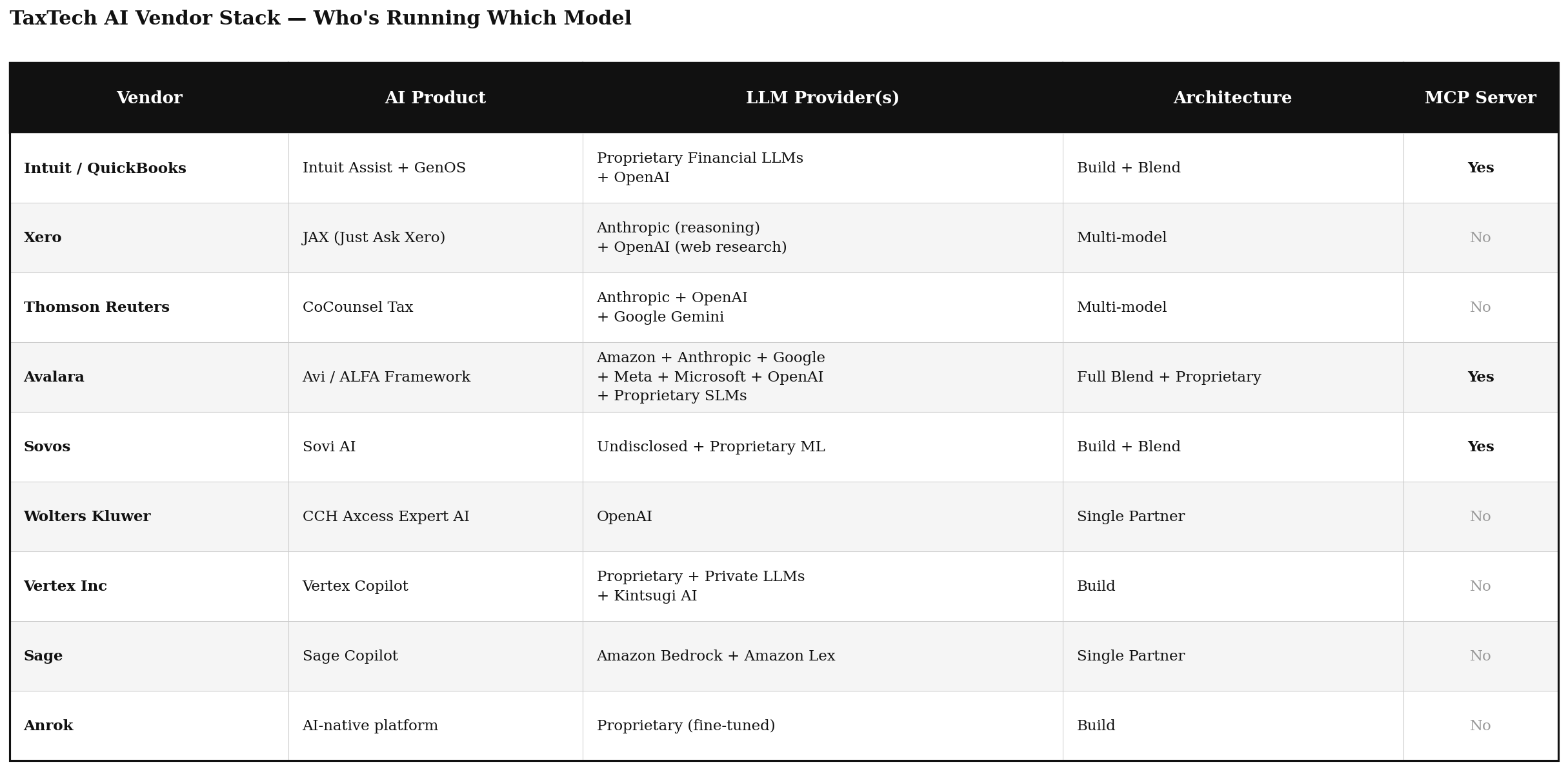
Thomson Reuters runs Claude, GPT-4, and Gemini simultaneously in CoCounsel Tax. Xero uses Anthropic for financial reasoning and OpenAI for web research. Avalara combines six providers with proprietary SLMs in its ALFA framework.
These multi-model architectures came to be on purpose, I think. When a frontier model gets a jurisdictional edge case wrong — and they all do — you want a fallback that isn’t the same model with a different temperature. Or when you run out of compute (tokens) during your period close, you want a fallback option. I wrote a full article about the contingencies you’d need in the future.
A reliance on a single model will most likely ruin your weekend.
🏗️ Intuit went the other direction — and it worked.
While everyone else built on top of frontier models, Intuit built underneath them. Proprietary Financial LLMs (GenOS), fine-tuned on financial data at scale: 90% accuracy on transaction categorization, 50% lower latency than off-the-shelf alternatives.
The case for owning your model is real — but only when the data flywheel justifies the build. If a vendor tells you they built their own AI, ask what data it was trained on. “We built our own model” without a data advantage is a marketing decision, not a technology one. And it won’t last.
As I covered in Your Tax AI Vendor Cannot Fix This — the constraint has never been the model. It’s the data layer underneath it.
VentureBeat, “How Intuit built custom financial LLMs that cut latency 50% while boosting accuracy”
🔌 MCP support is the integration signal nobody’s reading.
Avalara and Sovos have both shipped Model Context Protocol (MCP) servers. That’s how any AI agent can query a vendor’s compliance APIs using a standard protocol. No custom middleware.
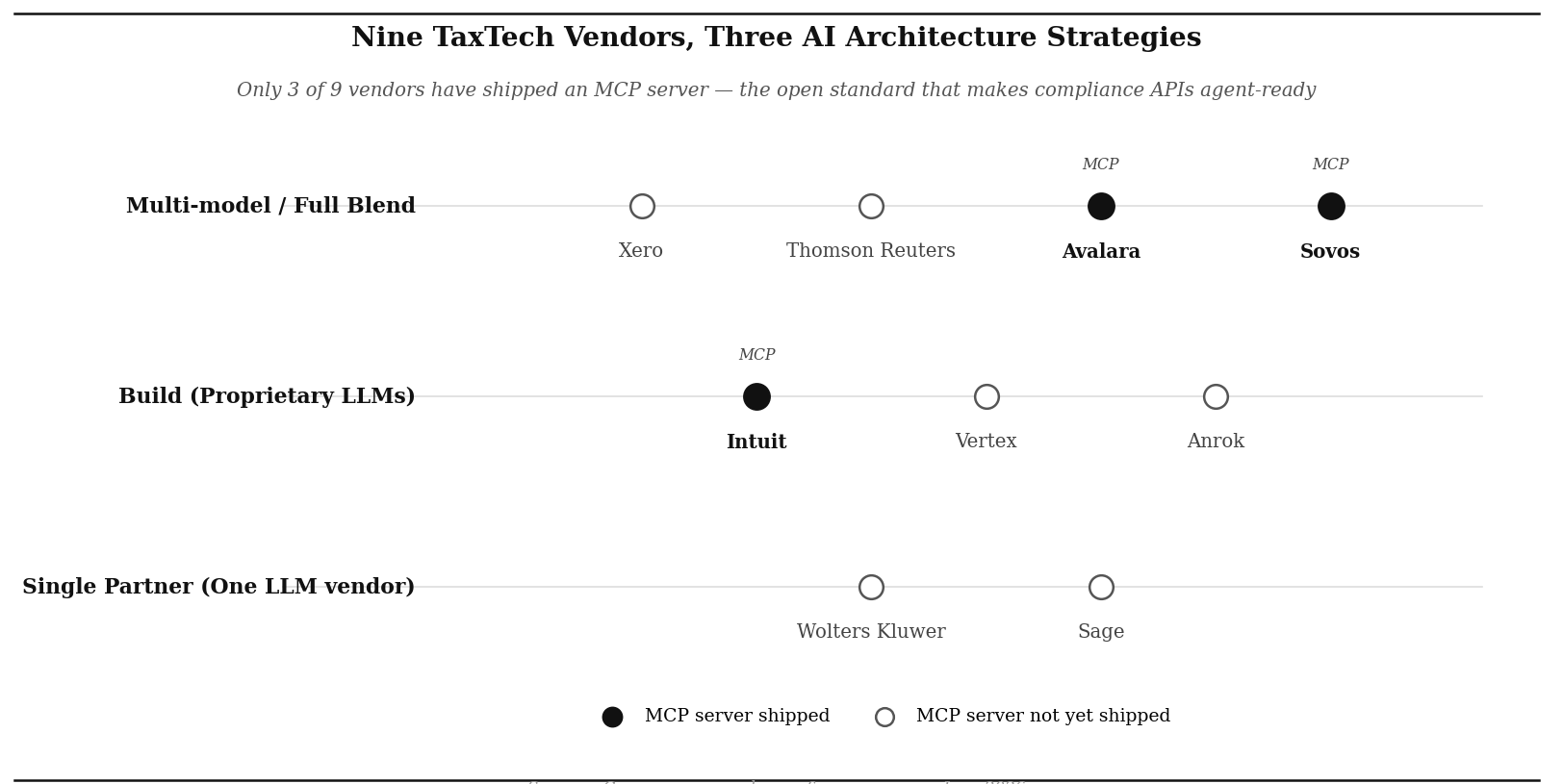
This is the difference between a vendor that’s an island and one that’s a node in your system. If your TaxTech vendor hasn’t shipped an MCP server, ask when it’s on the roadmap. If it’s not on the roadmap, you’re writing bespoke connectors — and maintaining them every time either side changes an API.
Avalara, “Connecting AI to Tax Automation: How MCP Servers Bridge the Gap,” November 2025
🤔 Every vendor calls it “agentic.” Ask what the agent actually executes.
Avalara’s Avi can ingest transaction data, calculate tax, validate exemptions, generate a return, and file it — autonomously, with human approval checkpoints. That’s an agent completing a workflow end-to-end.
Sage’s Finance Intelligence Agent routes your question to the right data source and composes an answer. That’s an agent retrieving and summarizing.
Both are called the same thing. The distinction matters enormously for how you architect around them. Before signing any contract with “AI agents” in scope, ask for a demo showing the agent completing a specific workflow from trigger to output. Not a slide. A working execution.
📋 The contract your organization signs this quarter is an architecture decision.
When a Tax Director signs a three-year deal with a single-LLM vendor and no MCP server, they’ve made a product architecture decision for their PM and engineering teams. They’ve locked in the integration surface, the agent compatibility layer, and the model fallback strategy — without realizing they’ve made that choice.
In Issue 004, I mapped every major AI partnership in TaxTech YTD. The pattern is consistent: AI capability is being acquired at the marketing layer, not the architecture layer. PMs who understand the stack before the contract is signed will have significantly more optionality in 18 months. Those who don’t will be managing a migration.
The question I keep coming back to: why aren’t product teams in the room during TaxTech contract negotiations? Reply and let me know if that’s changing at your organization.
References
Xero — “Xero and Anthropic Collaborate” — https://www.xero.com/us/media-releases/xero-and-anthropic-collaborate/ — June 2026
Avalara — “Avalara Launches Agentic Tax and Compliance™” — https://newsroom.avalara.com/2025-09-30-Avalara-Launches-Agentic-Tax-and-Compliance-TM-AI-Agents-That-Work-for-You — September 2025
Avalara — “MCP Servers Bridge the Gap” — https://www.avalara.com/blog/en/north-america/2025/11/model-context-protocol-servers-bridge-the-gap.html — November 2025
Sovos — “Sovos Expands Sovi AI” — https://sovos.com/press-releases/sovos-expands-sovi-ai/ — March 2026
Thomson Reuters — “One Million Professionals Turn to CoCounsel” — https://www.thomsonreuters.com/en/press-releases/2026/february/one-million-professionals-turn-to-cocounsel-as-thomson-reuters-scales-ai-for-regulated-industries — February 2026
VentureBeat — “How Intuit Built Custom Financial LLMs” — https://venturebeat.com/ai/how-intuit-built-custom-financial-llms-that-cut-latency-50-while-boosting — 2025
Wolters Kluwer — “CCH Axcess Expert AI Launch” — https://www.wolterskluwer.com/en/news/wolters-kluwer-launches-cch-axcess-expert-ai — November 2025
Vertex Inc — “Vertex Advances AI-Powered Capabilities” — https://www.globenewswire.com/news-release/2026/04/07/3269067/0/en/Vertex-Advances-AI-Powered-Capabilities-to-Improve-How-Enterprises-Execute-Compliance.html — April 2026
Sage — “Sage Debuts Finance Intelligence AI Agent” — https://www.channelinsider.com/ai/llms-chatbots-and-agents/sage-finance-intelligence-agent/ — 2026
Intuit — “GenOS Press Release” — https://investors.intuit.com/news-events/press-releases/detail/1272/intuit-rapidly-advances-genos-to-accelerate-development-of-agentic-ai-experiences-at-scale — 2025
Great article. As a tax tech vendor, I agree that model choice, MCP and execution capability matter today.
Although multi-model architectures, MCP servers and agent frameworks are already becoming table stakes.
So then the architecture underneath the AI may ultimately matter more than the model sitting on top of it.