

Imagine it’s 2010, and you've just graduated and joined the Tax Department of an S&P 500 company. You are eager to learn and can’t wait for a task to land on your desk. You don’t have to wait long, as you quickly receive a typical junior VAT reporting task. Pull the month’s revenue out of accounts receivable. Split it into reporting streams in a spreadsheet. Then check, line by line, whether the VAT rate applied matches the rate the law requires. Many times, it doesn’t.
The importance, repeatability, simplicity of execution, and relatively high effort make this task suitable for someone starting in taxtech. It’s a great opportunity to learn the peculiarities of VAT reporting, where the company’s income comes from, and how upstream technology systems work. One can even gather some bragging rights for preventing inaccurate monthly returns.
Fast forward to 2026. An agent can now run that check in seconds. The news is plastered with doomsday scenarios claiming the junior role is finished.
I think that’s wrong. As with previous technological revolutions, we will find ways to prevent unemployment. The alternative means civil unrest and chopping heads, as we Europeans learned a long time ago.
I also believe AI won’t kill the junior role, but we will need to tweak the accidental training that came with it. Two weeks ago, in Judgment, Not Building, I argued that the scarce skill in an agent-run tax function is judgment, and that people learned it by doing the routine work agents now take. The obvious next question is: so what do we do about it?
This article is my answer. It’s for the people who run tax and product teams, and for the juniors joining them.
What the Spreadsheet Actually Taught
Nobody designed that AR exercise as training. It was just work that needed doing. But think about what a junior used to pick up by month three:
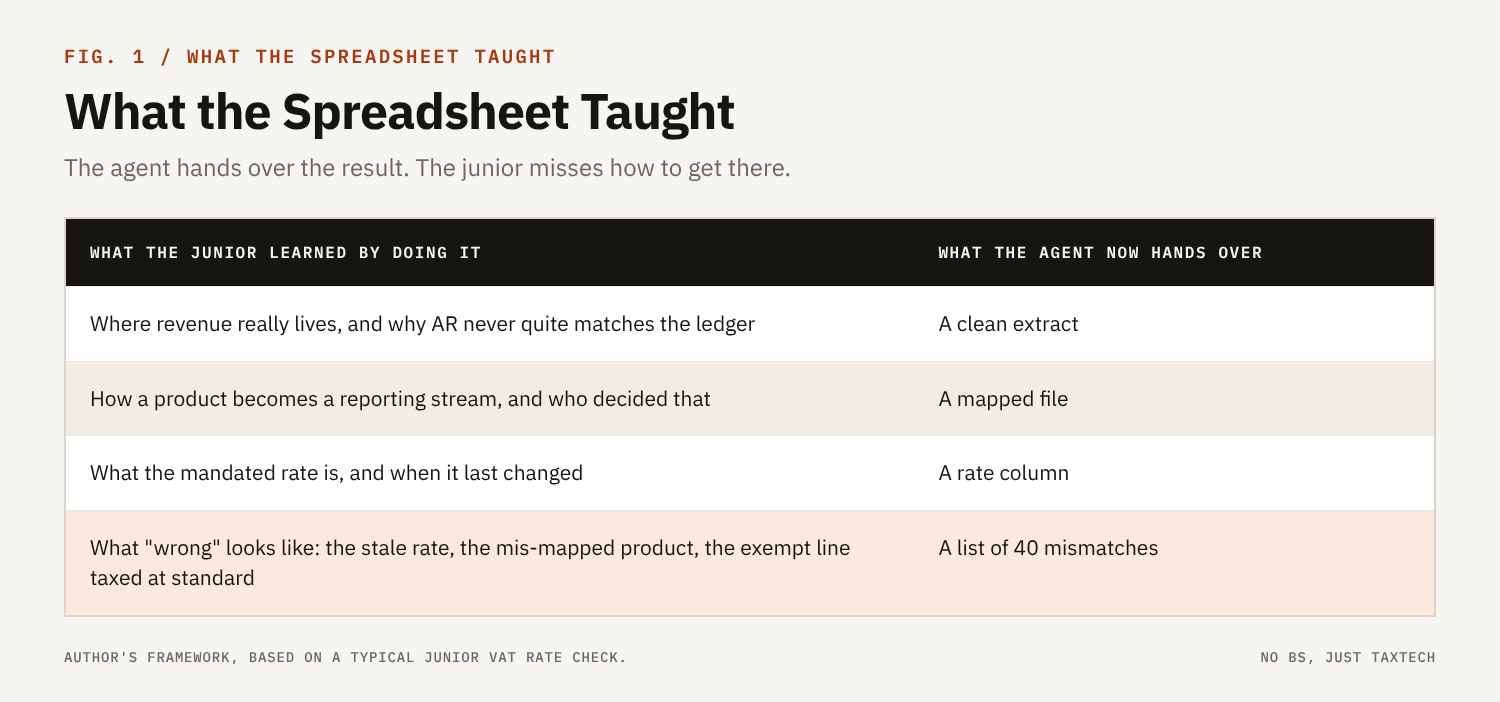
All of these learnings came by reasoning while doing the necessary work. In other words, you got a feel for what was wrong by finding it yourself, many times, and then chasing why it happened. Was it the tax engine? The product catalog? A rate change nobody pushed to production? You had to logically tie all the pieces together, understand the context, terminology, and flow to troubleshoot. At the same time, this became knowledge and good judgment. Now the agent runs the comparison and hands the junior a list. The junior gets the answer without the knowledge lesson.
Why “Make Them Reviewers” Isn’t Enough
So far, the profession’s answer is to move juniors up faster. PwC trains junior accountants to act like managers within three years. The logic goes: if agents do the preparation, juniors can skip the grunt work and go straight to review. Some even argue that’s better training than matching transactions all day.
I understand the appeal, and part of it is true. Nobody misses writing VLOOKUPs in spreadsheets to check for incorrect tax rates. But I see three problems with skipping straight to review.
First, it’s hard to review what you’ve never done. A cross-border B2B line with no VAT under the reverse charge is correct, even if it looks wrong next to the domestic rate. To tell the two apart, you need a picture of what right looks like. Carl Mayes of the AICPA put it as a question: how do you know what good looks like if you’ve never done the work yourself? Without that picture, a first-year will approve what looks fine and reject what looks odd. That’s pattern-matching on how things look.
Second, a review only covers what’s on the list. The most expensive errors are often the ones the agent never flags. If the rate table the agent checks against is out of date, a stale rate matches it perfectly, and nothing shows up. If a revenue stream is booked straight to the ledger and never reaches the AR extract, it isn’t on the list at all. Only someone who has done the reconciliation by hand asks: what’s missing?
Third, in tax, a review isn’t a formality. It’s a signature. As I wrote before, HMRC, the IRS and Australia’s Tax Practitioners Board all say the same thing: if you file it, you’re responsible for it, whoever prepared it. So a junior can’t learn in the reviewer seat unless a senior checks everything behind her. And that’s already happening. McKinsey describes juniors who struggle to explain or defend what the AI hands them, leaving their bosses with a growing pile of work to check themselves. The time the agent saved simply moves up to the senior.
Put together, review is where a junior should end up, not where she starts. She needs some of the doing first. The real question is how to give her that without going back to the old grunt work.
How to Instill Judgment in Junior Hires
1️⃣ Start the apprenticeship with a first pass. Before the agent runs, let the junior do one slice of the month by hand: pull the AR extract, map the streams, check the rates. Then put her version next to the agent’s and go through the differences with a senior. McKinsey suggests a similar approach: junior first, AI second, manager in the middle.
If you need this at scale, simulate it. KPMG US is building TaxSIM, a simulator meant to replace years of return prep with fast, repeated practice, and plans to roll it out to 10,000 tax staff. In VAT, a much cheaper version is a synthetic AR file with a few wrong rates planted in it. How many does your new hire find?
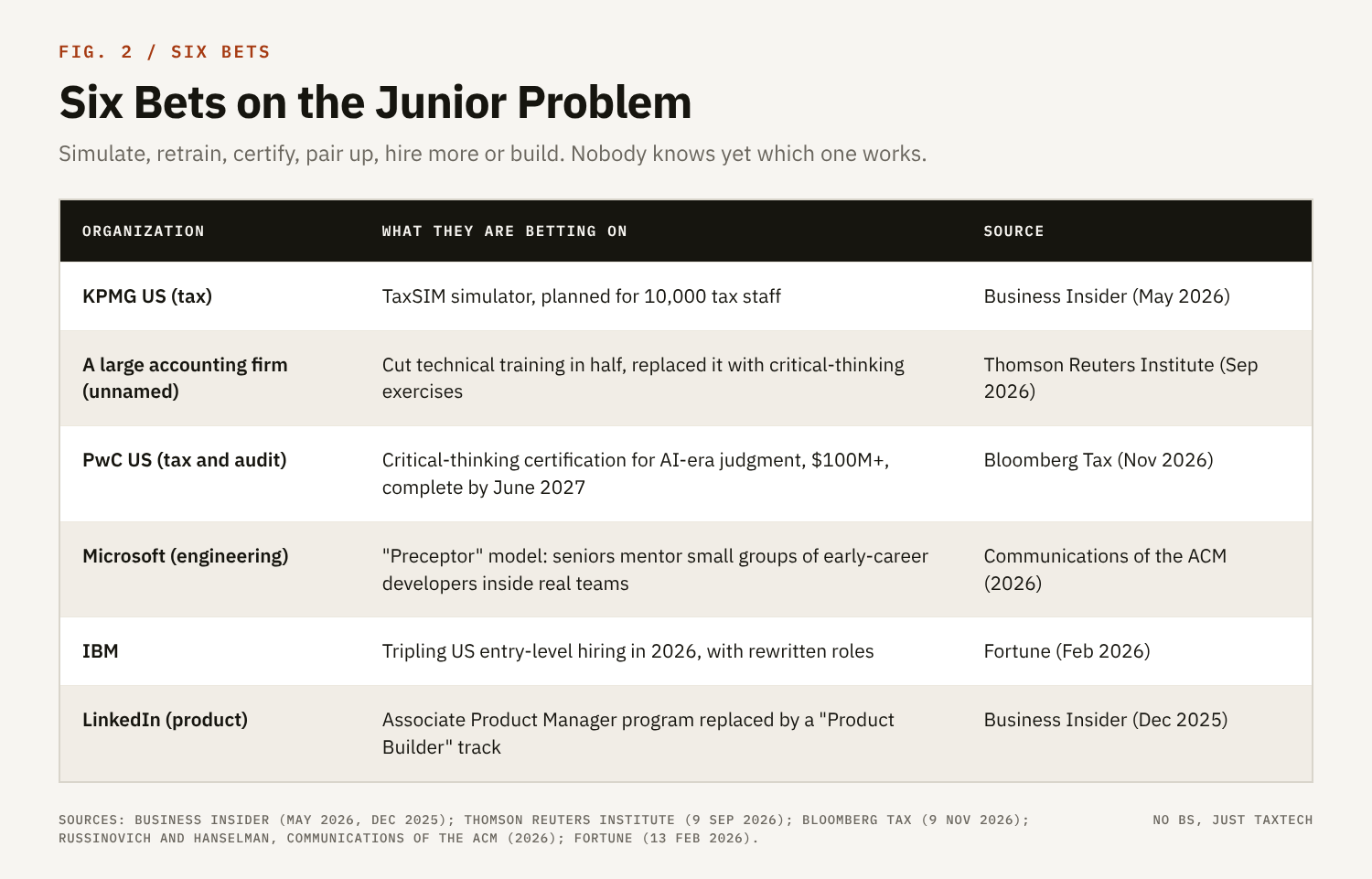
2️⃣ Protect the intake. IBM went against the market here. Its HR chief, Nickle LaMoreaux, is tripling US entry-level hiring, even though she admits AI can do most of the entry-level jobs from two or three years ago. IBM rewrote those jobs instead of removing them.
In tax, this matters even more, because a human has to sign. If you cut juniors today, you create the reviewer gap I described last time: around 2031, nobody with five years of hands-on work will be able to step into the reviewer seat. So I’d put the junior budget inside the AI business case, instead of counting the missing juniors as the saving that pays for the agents. I wrote about a similar trap in how tax AI gets priced.
3️⃣ Rethink the team shape and measure judgment. The fashionable new shape is the “diamond”: fewer juniors, more mid-career experts and specialists. It may work for a few years. But where does your middle come from after that? Not very clear. Instead, I recommend investing in junior hires nevertheless. One tool I’ve found that helps junior hires develop judgment ASAP is Gleb Tsipursky’s “apprenticeship ledger”. It can be turned into a framework for growth:
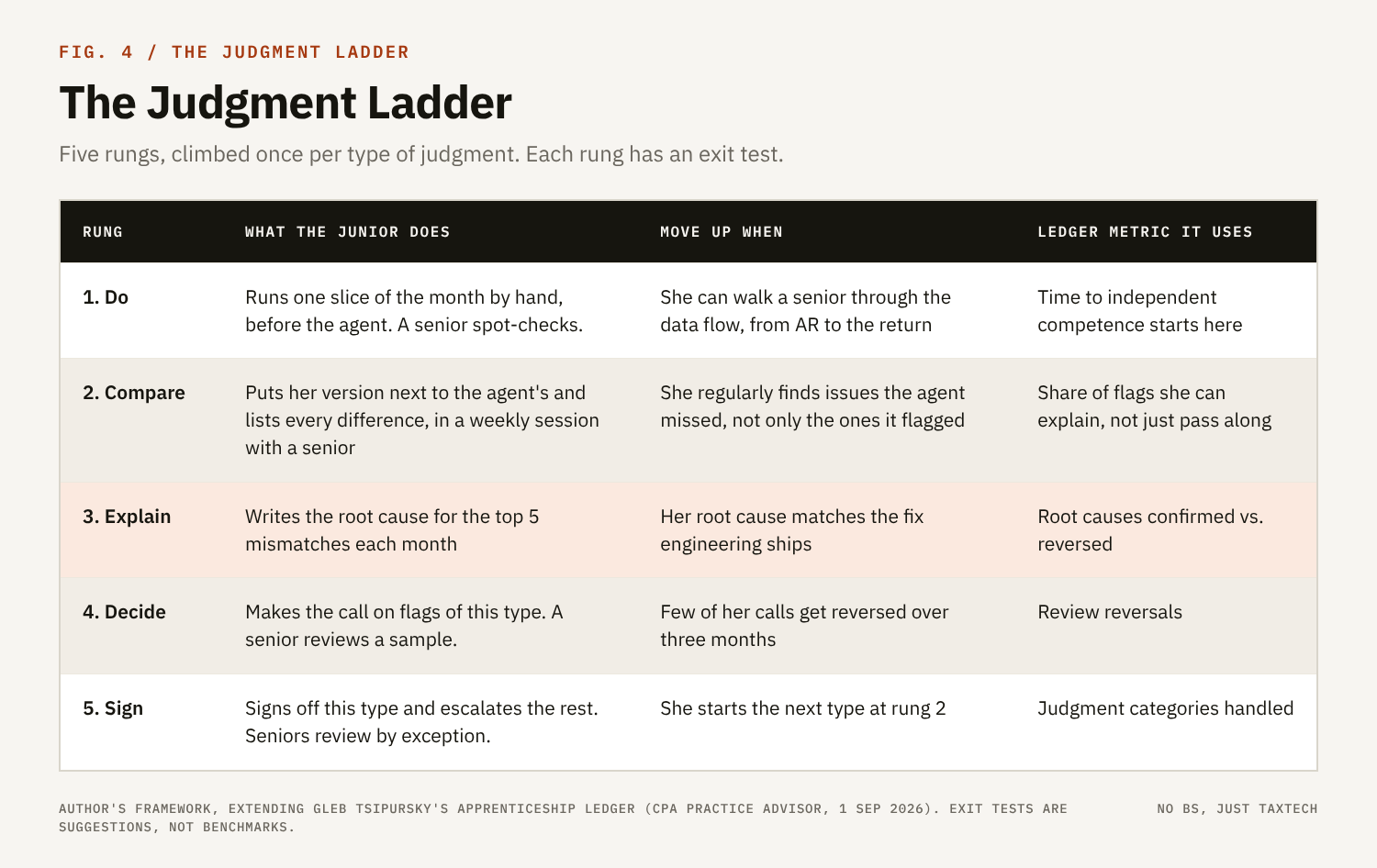
It uses AI as a growth tool rather than a way to skip important lessons. This approach was also already used at Anthropic. 52 mostly junior engineers learned a new library, with or without AI. Quiz scores were lower with AI: about 50% versus about 65% without, and the speed gain wasn’t statistically significant. But participants who showed stronger mastery used AI not just to produce code, but to build comprehension.
What to Do if You are a Junior Hire
If you’re just starting out, you don’t have to wait for your employer to fix this.
1️⃣ Do the first pass, even when nobody asks you to. Go through one month by hand before you open the agent’s output. Yes, it’s slower. That’s where the learning happens.
2️⃣ Ask “Why?” about every flag. A mismatch is only a symptom. Find the cause: the engine, the catalog, the rate table, or the person who did the mapping. The cause is what engineering can actually fix. Tip: you can use AI to find this, and you'll learn a lot in the process.
3️⃣ Keep a log of what went wrong. Write down every error you catch, and every one you miss, with a one-line explanation. After two years, that log will have taught you more than most certificates. And if you’re still choosing between the tax and the product path, I compared both roles here.
A planted error file is how I test chatbots too. On a fake month end Gemini found a $3,800 freight reclass and never said it left total spend unchanged. That gap is a lot easier to spot if you've done the first pass yourself