

Something monumental happened this year. For the first time in the short history of the Internet, (ro)bots viewed more webpages (in tech jargon, they made more HTML content requests) than humans:
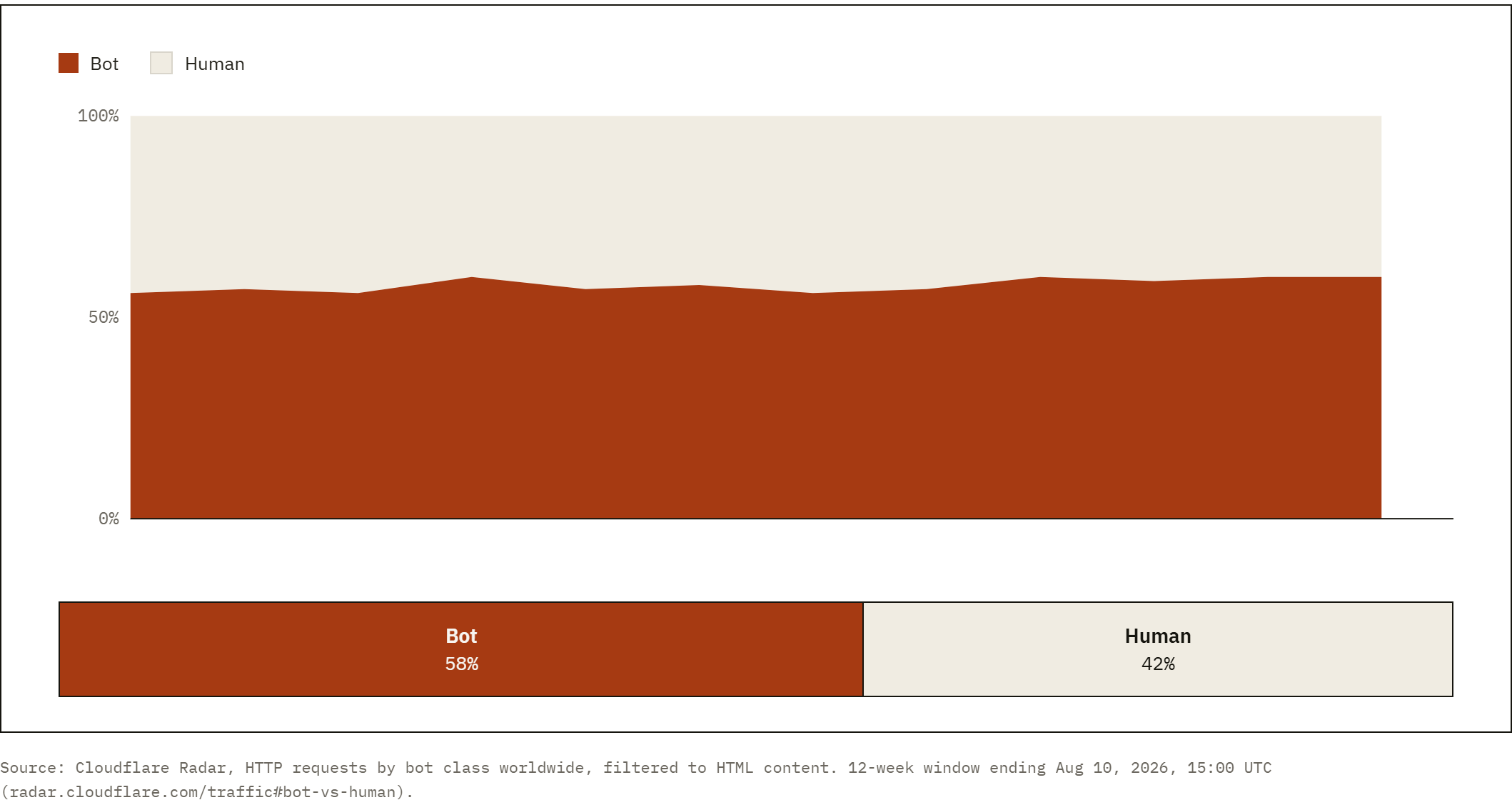
In other words, the web stopped being a network where humans read pages and became a network where machines fetch data. What is more, it’s a matter of time before bots become the primary buyers of online goods and services at the request of humans. How do I know this? Nearly 50% of shoppers now use ChatGPT or another bot-based means for research before an online purchase. This is an early signal that AI agents will expand the traditional checkout flows by not only searching, comparing, selecting, but also purchasing on behalf of shoppers.
So, why should we in the tax and accounting world care? Well, read below for some examples.
Users = Bots but Do Tax Autnorities Know This?
Currently, 8 EU jurisdictions, Turkiye and the UK charge a Digital Services Tax (i.e. a % tax on the revenues derived from users of social media platforms, search engines and online marketplaces of residents in those jurisdictions):
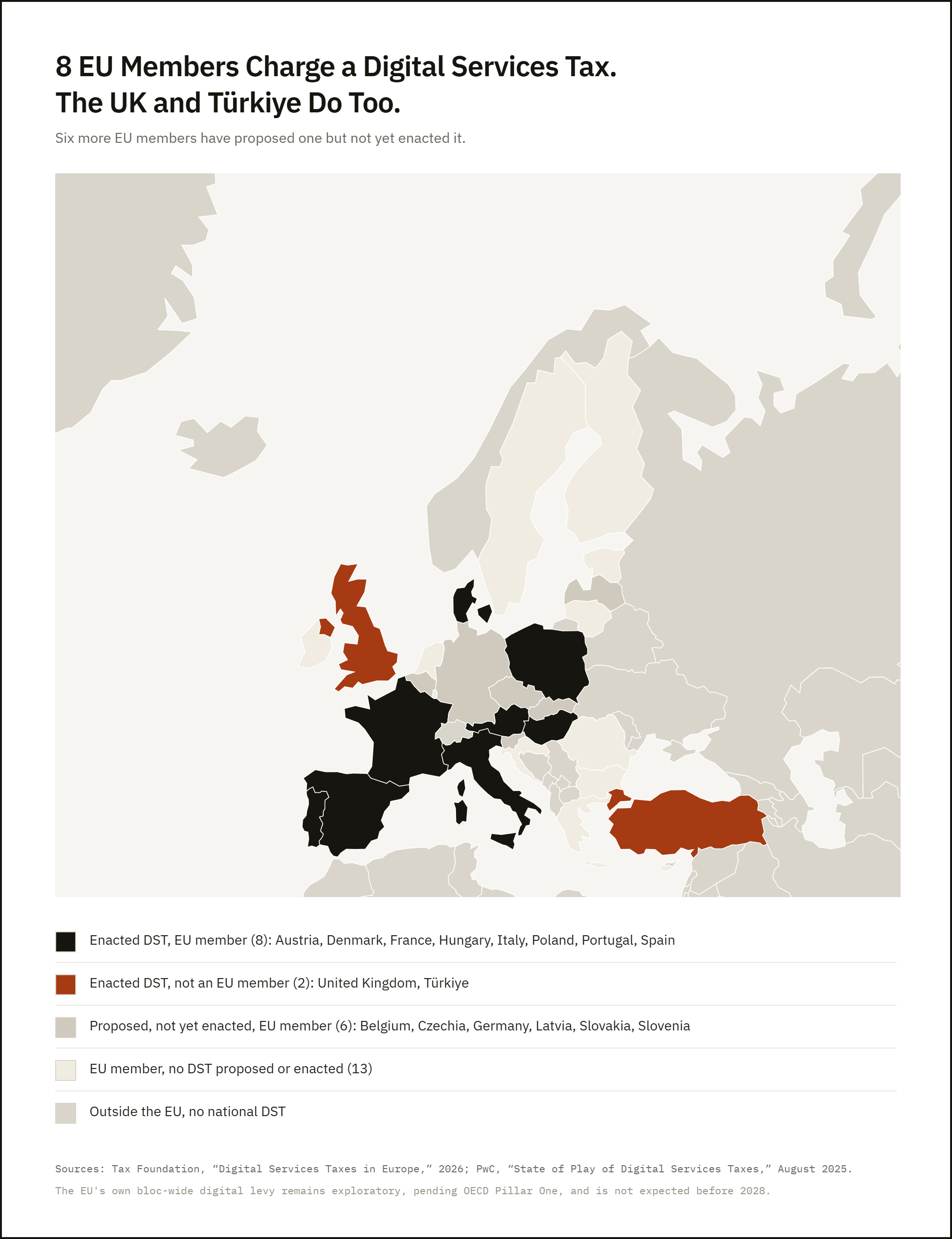
Here’s the catch - how do you prove that the “user” is a real person and not a bot pretending to be based in the jurisdiction? The HRMC’s guidance is to establish user location from IP address, delivery address, payment details, and ad-targeting data. All of those can be spoofed easily by a bot depending on the infrastructure setup. The Internet forums are full of examples in which the majority of traffic to personal blogs and other websites comes from China/Singapore/Gibraltar, which are definitely not where those websites’ target audience resides. So, what happens if a bot with a Chinese IP is tasked by a shopper in Spain to buy a book on a UK website?
I would start thinking about how to determine and optimize DST now.
The Rise of MABs and DABs
Right now, many growth PMs and other folk live and die by monthly active users (MAUs) and daily active users (DAUs). To put it simply, we count how many new and returning users come to a web page or an app every day/month (once or more than once). Well, soon we will be counting monthly active bots (MABs) and daily active bots (DABs), obviously. Why? Because those figures land in presentations to shareholders and earnings calls.
Just ask Roblox and X (formerly Twitter). Roblox disclosed 79.5 million average daily actives for Q2 2024. Hindenburg Research published a report alleging 25 to 42% of that figure was alternate accounts and bots, built on their own analysis. Roblox called the report misleading and, notably, did not publish a specific counter-number but not before the company’s stock price took a hit. Twitter had disclosed 5% of accounts as spam and fake in its own regulatory filings before Elon Musk acquired the company (and argued that the % is much higher, therefore, he allegedly was misled to overpay for the purchase).
Obviously, bots have a way of messing up with M&As and future earnings expectations (aka current stock prices). Better start planning how to mitigate that impact (as it’s mostly been negative).
How Do You Tax Pay-Per-Crawl?
One of the more forward-looking aspects of the rise of bots is that we will soon have new revenue sources. We all know that to be good at what they do, bots need to learn through scouring the content already available on the Internet. Well, why should this be free, you may ask as a content creator? Right now, the ratio of page content dowloads to referrals is overwhelmingly skewed towards the bot creators:
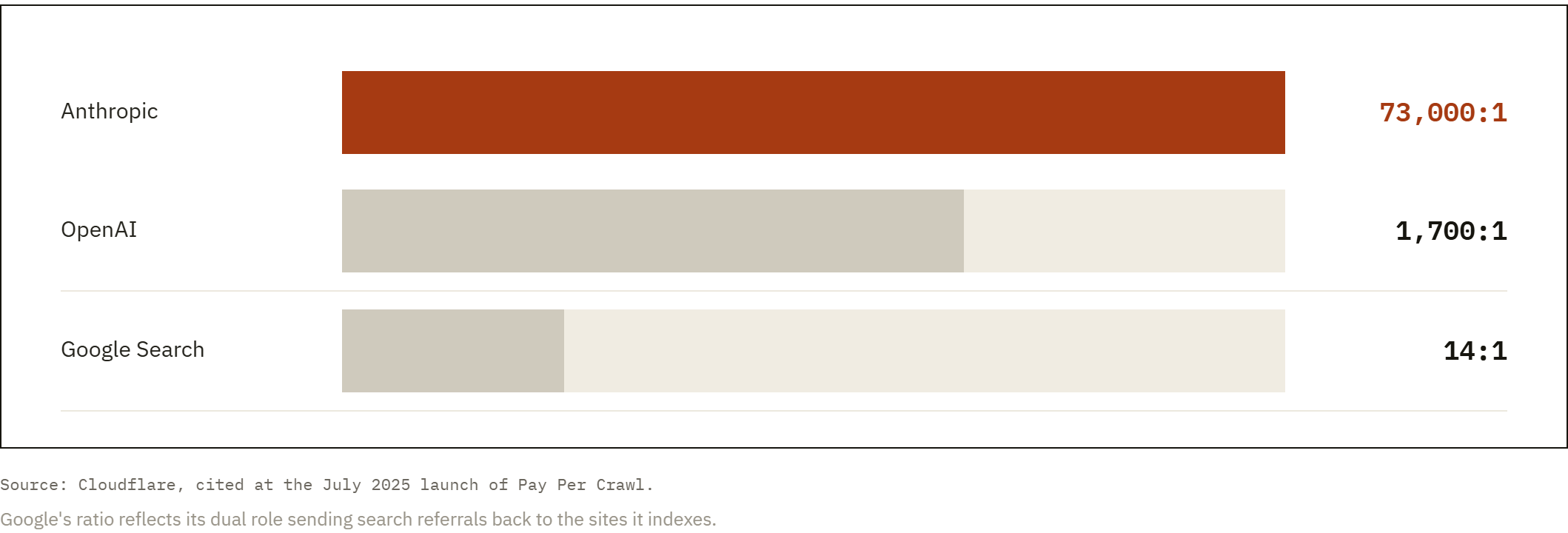
Anthropic’s crawler fetches a page 73,000 times for every referral it sends back. OpenAI’s ratio is 1,700 to 1. Google, for comparison, a company that actually needs you to visit the sites it indexes, sits at 14 to 1. Cloudflare cited these numbers when it launched Pay Per Crawl in July 2025, and they’re the reason publishers are starting to charge AI companies for machine access to their content.
Well, the business model makes sense but wait until it lands on the tax manager’s desk. A cross-border payment for an AI company’s crawler to fetch your tax commentary, is that a royalty under Article 12 of a tax treaty, subject to withholding, or a service fee under Article 7, taxed only where the payer has a permanent establishment? How do you determine that for a product that didn’t exist eighteen months ago?
The Big Waste on the Income Statement
Cloudflare again has some interesting numbers:
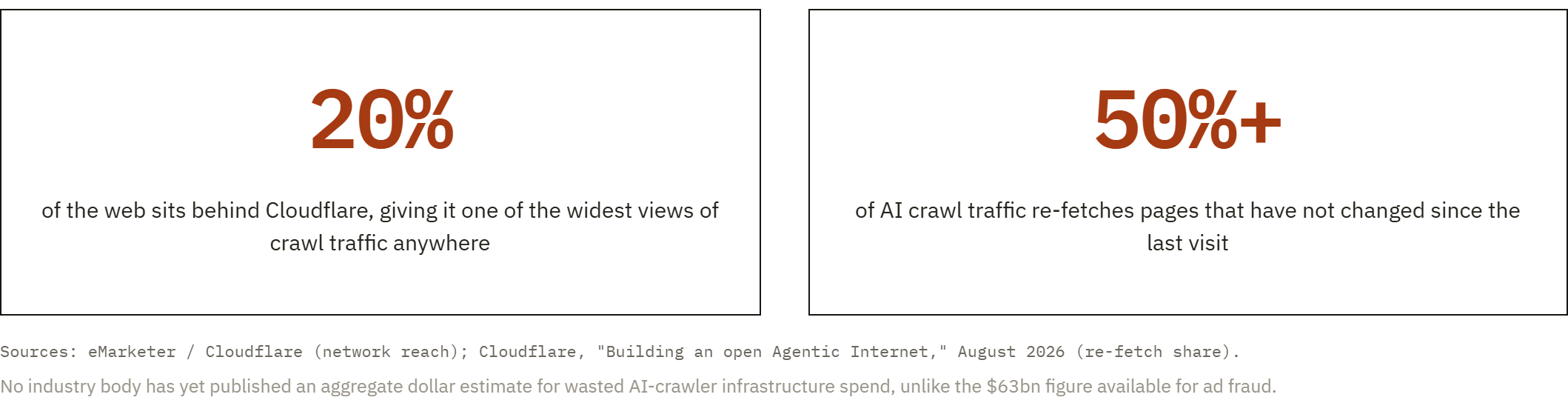
Roughly, 1 in 5 websites sits behind Cloudflare’s CDN. The more interesting data point is that more than half of all bot visits are wasted. The bot comes back to check a page, but the page hasn’t changed since the last check. The catch is that somebody pays for this, and it ends up as a cost on the income statement because every one of those visits uses bandwidth and server capacity. Here’s a comparison to what this does to paid advertising traffic: approximately $63 billion has been lost to invalid ad traffic in 2026, 8.5% of all ad traffic worldwide.
No matter if the webpage visitor is a bot or a human, we need to serve, store, and process traffic. So, this cost attributed to bots that will never file a return, never buy a subscription, never do anything but check the page and leave has to be incorporated in the company’s earnings statement or else (see previous section).
We urgently need a framework describing how to determine and isolate that cost, preferably with GAAP in mind.
A Framework for World in Which Bots Outnumber Us
Here’s where I’d start, mapped to the four problems above:
1. Verify the user, don’t just count the request.
Before you rely on IP address, delivery address, or ad-targeting data to establish where a DST-triggering user sits, ask whether that signal survives a bot wearing a VPN. Build a documented, defensible counting methodology now, the same way you’d document a transfer pricing position, rather than waiting for a tax authority to ask why 40% of your “UK users” resolve to a data center in Singapore.
2. Disclose the bot-adjusted number, not just the headline number.
If MAU or DAU shows up in an earnings call, it’s going to get the same scrutiny revenue recognition gets. Get ahead of it. Publish your bot-filtering methodology as a footnote before a short seller publishes their own estimate of it for you.
3. Classify the payment before you send the invoice.
If you are dealing with a new revenue source such as pay-per-crawl decide in advance how to treat this. Don’t try to reconstruct after the first cross-border payment lands and someone in finance asks what code to book it under.
4. Give bot-serving cost its own line.
You can’t manage what you haven’t isolated. Bandwidth, compute, and support tickets spent on traffic that will never convert are a real cost today, they just don’t have a name on the income statement yet. Start tracking it internally now, GAAP guidance or not, so you’re not building the number from scratch when a regulator or an investor asks for it.
None of these are hard problems individually. What’s hard is that they’re landing on tax and finance teams at the same time, for the first time, with no existing playbook. The teams that write their own version of this framework now, instead of waiting for one to arrive from the outside, are the ones who won’t be caught explaining a bot problem after the fact.
References
HMRC, “Check if you need to register for Digital Services Tax” | https://gov.uk/guidance/check-if-you-need-to-register-for-digital-services-tax
India Income-tax Rules 2025, Rule 13, Significant Economic Presence | via Patron Accounting, “SEP Rules 2026” | https://www.patronaccounting.com/blog/significant-economic-presence-sep-rules-2026-thresholds-non-resident
Hindenburg Research, “Roblox: Inflated Key Metrics” | https://hindenburgresearch.com/roblox/ | October 2024
Roblox Q2 2024 shareholder letter
CBS News, “Jury finds Elon Musk liable for misleading investors during Twitter purchase” | https://www.cbsnews.com/amp/news/elon-musk-liable-for-misleading-investors-during-twitter-purchase-jury-finds/ | 20 March 2026
eMarketer, “Cloudflare marketplace lets websites charge AI bots for scraping” | https://www.emarketer.com/content/cloudflare-marketplace-lets-websites-charge-ai-bots-scraping
Cloudflare, “Building an open Agentic Internet” | https://blog.cloudflare.com/the-agentic-internet/ | 6 August 2026
ANA, “Global Invalid Traffic Report 2026” (Lunio) | https://www.ana.net/magazines/show/id/news-2026-01-21-global-invalid-traffic-report-2026 | 21 January 2026