

Two weeks ago, we got a first look at what a heavily AI-augmented organization may look like. Anthropic published data on its own workforce, showing what happens when agents do most of the work. So, why does this matter in the taxtech world?
Most of the AI conversation in taxtech is about building: how to build a P&L with Claude, how to write a good prompt, set up an agent, automate a workflow. While this skill set matters, I think we should also consider other macro factors. Building gets easier every month. For example, at Anthropic, non-technical staff went from 2 coding-agent sessions a month to 90 in under a year. Of course, using agents for reconciliation has a learning curve compared to the good old spreadsheets, but evidence shows taxtech folks are getting there.
However, Anthropic’s data shows that increased agent use has rippled into other areas: employee hiring and retention, agent supervision, everyday work routines, and the overall need for human judgment at scale. Until two weeks ago, I had a hunch about this, but no numbers. Now we have data-backed indications, which I’ll use to preview what’s coming to the taxtech world.
Fewer Juniors Coming In
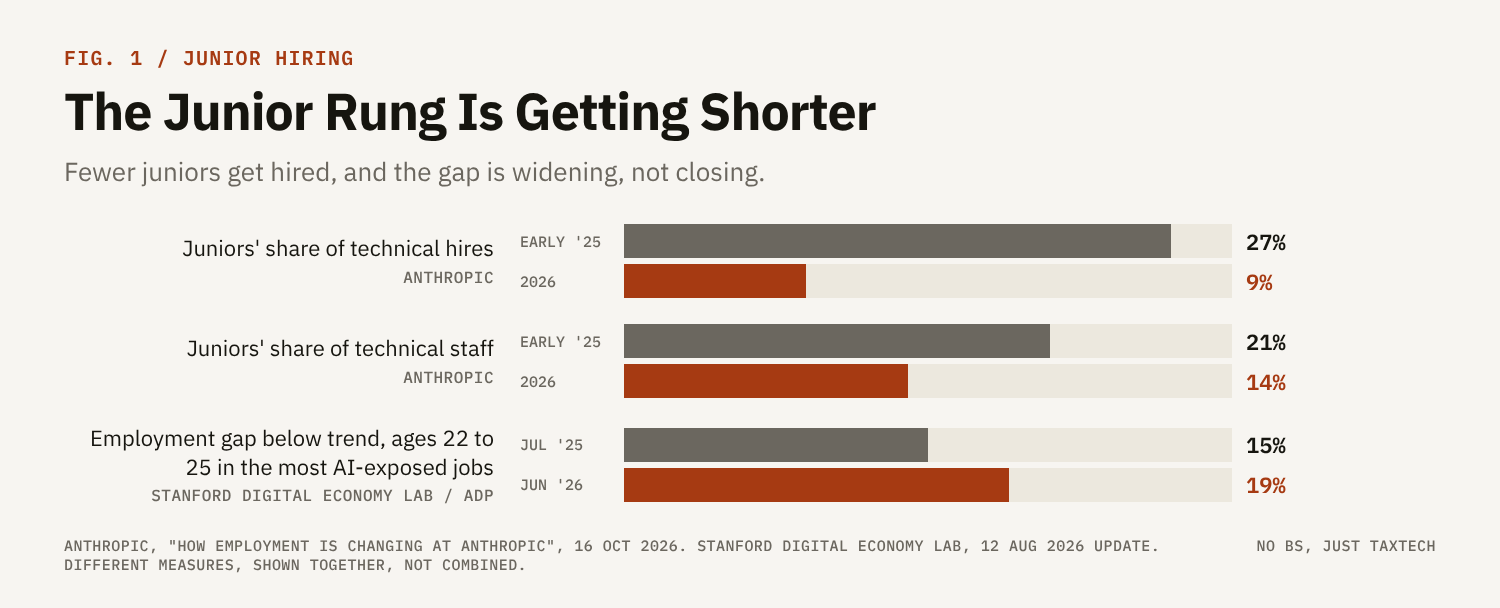
Let’s start with who gets hired. At Anthropic, about one in four new technical hires used to be junior. Today, it’s about one in eleven (down from 27% to 9%). The report doesn’t say why, but I guess automation has matured enough to handle most junior-level tasks.
You could say that’s just one AI lab. But Stanford’s Digital Economy Lab sees the same pattern in ADP payroll data across the US. In the jobs most exposed to AI, employment for 22- to 25-year-olds is about 19% below where it should be. Put simply: for every five young people you’d expect to see in those jobs, roughly one is missing. A year earlier it was 15%:
I see two problems with this trend. First, in the taxtech domain where governments mandate that humans sign and be accountable for all reporting (i.e., exercise judgment), limiting junior hiring will show up as a gap around 2031, when nobody with five years of hands-on work can be promoted into the reviewer seat. Second, the juniors who do get in are expected to start higher. PwC found entry-level roles in AI-exposed jobs are seven times more likely to ask for skills like judgment, which used to come years later.
Where the Saved Time Goes
But if people keep deciding and signing, where does the time the agents save actually go?
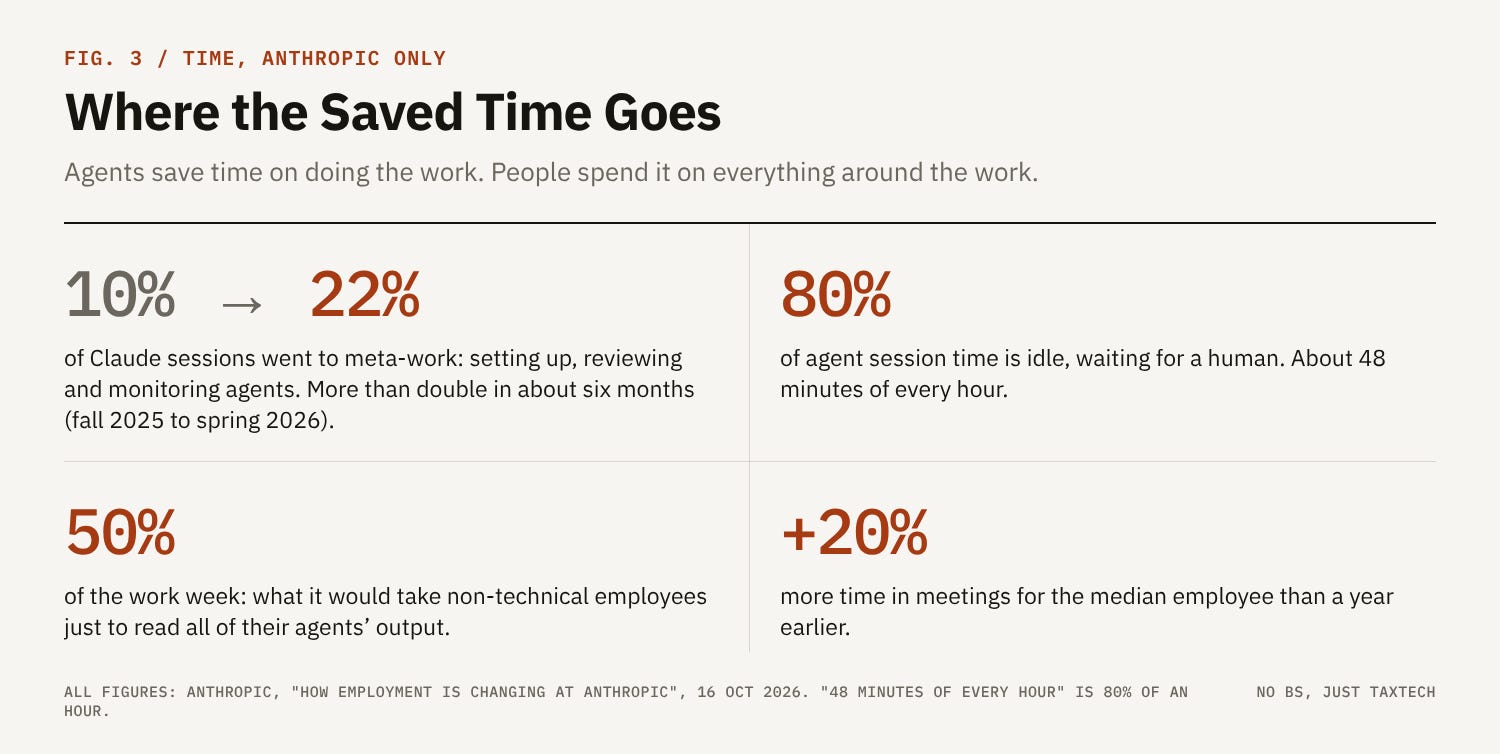
At Anthropic, a lot of it went into “meta-work”: setting agents up, reviewing what they did, watching the pipelines. In about six months, its share of Claude sessions went from 10% to 22%. Second, the agents mostly wait for people. About 80% of a session is idle, waiting for a human. In an hour, that’s 48 minutes of an agent waiting for a human to exercise judgment. Third, just reading what the agents produce is a job in itself. For non-technical employees, reading all their agents’ output would take half their workweek.
In the taxtech world, reading every output is obligatory. The person who signs is liable for what the agent prepared, so you can’t skip a review to save time. That’s why I’d plan for this development early on. If we benchmarked against Anthropic’s data, I’d allocate at least a day a week per person to set up and check agents. If your business case shows the saved hours going straight into “higher-value work”, it’s missing this line. That’s a hidden cost I wrote about before.
How Far the Agents Go
Fewer juniors, then. So who does the work instead?
At Anthropic, the agents passed people in hours worked in March 2026. By August, for every hour a person worked, their agents put in six. Finance is behind, but heading the same way. BCG describes close agents that match, reconcile, and flag exceptions on their own, while analysts approve only the high-risk entries. At Gartner’s finance symposium in June, autonomous accounting was described as a world where “journals are reviewed rather than created.”
In tax, though, this hits a ceiling, and the ceiling isn’t technical. As I wrote in before, HMRC, the IRS and Australia’s Tax Practitioners Board all say it: if you file it, you’re responsible for it, whoever prepared it. In the Thomson Reuters Institute and TEI survey from the end of October, more than four in five (84%) want AI kept out of some areas, even with controls. That’s why I find it useful to think of tax work in four levels:
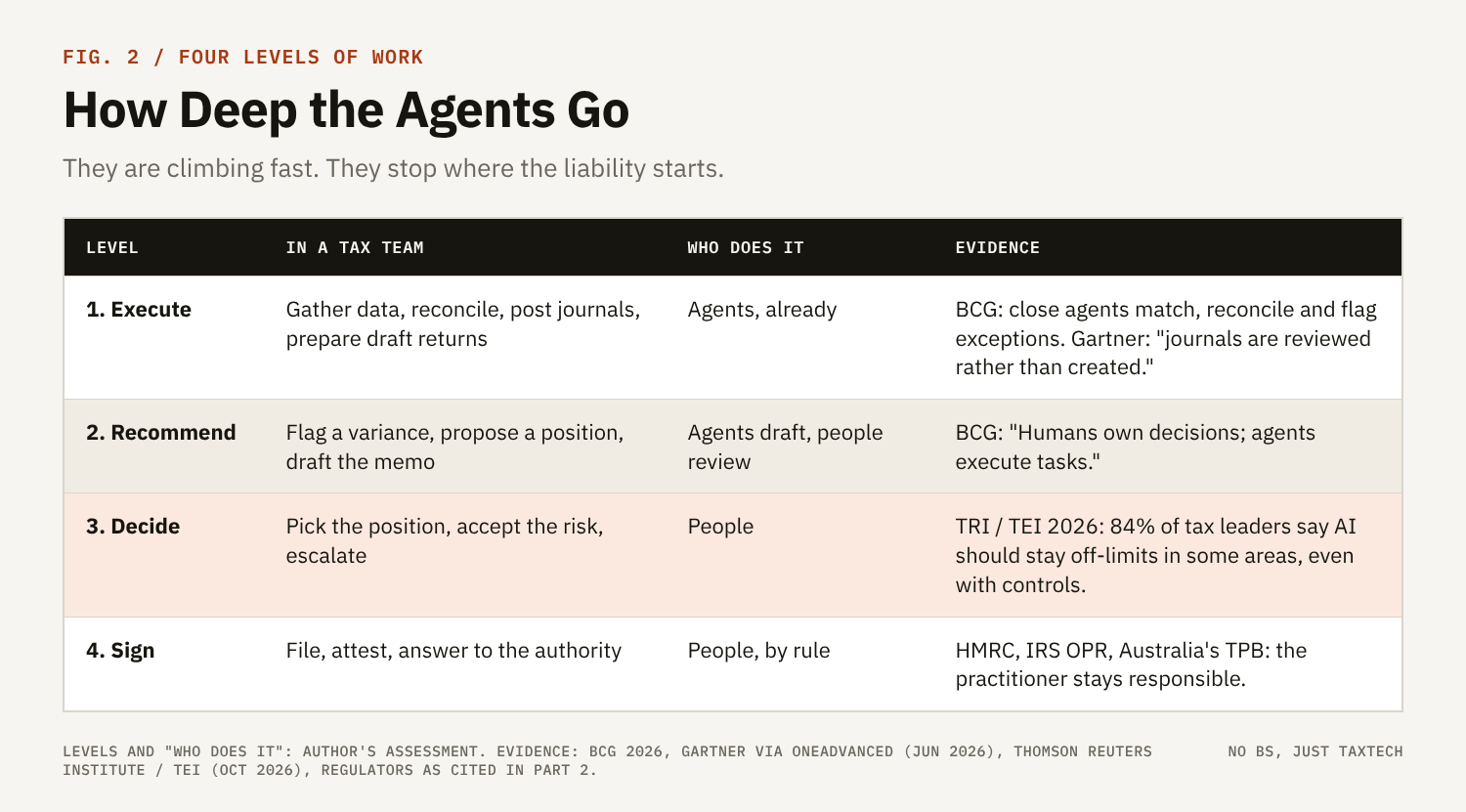
Agents already own the first level, and they’ll take most of the second. People keep the third and fourth. In other words, humans own decisions; agents execute tasks.
A Tuesday in 2028
So what does a normal day look like when agents are so active? I’ll take the role I know best, a TaxTech product manager at a large company. This is my guess, built from the Anthropic report, and I’ve penciled in the agents’ day too:
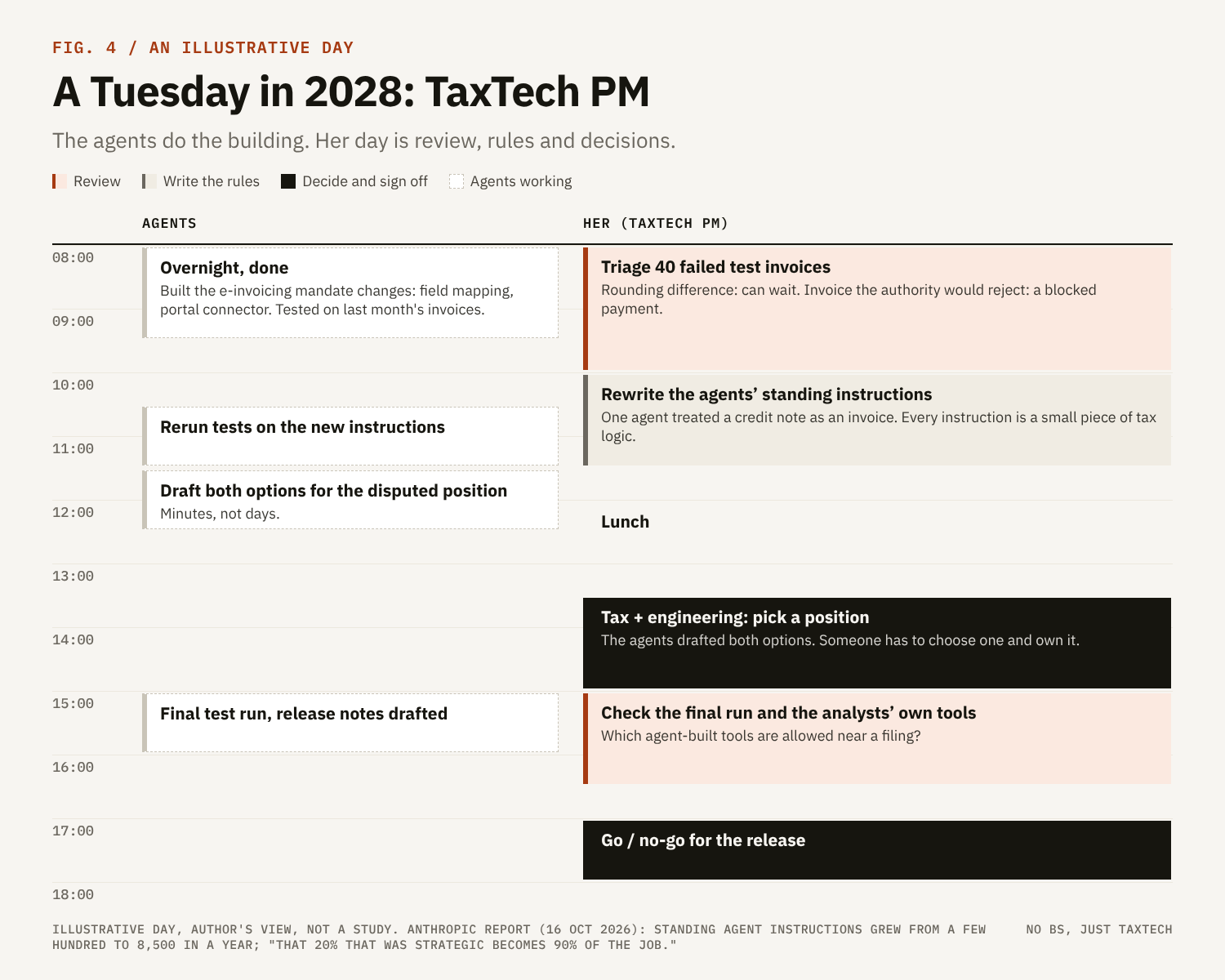
The PM starts with a queue, not a blank spec. Overnight, the coding agents built the changes for a new e-invoicing mandate: the field mapping, the connector to the tax authority’s portal, the test runs against last month’s invoices. They also left her a list of 40 failed test invoices. Her job is to decide which of those failures matter.
Mid-morning, she rewrites the standing instructions agents follow because one of them treated a credit note like an invoice. At Anthropic, these written instructions for agents grew from a few hundred to 8,500 in a year. In TaxTech, each one is a small piece of tax logic. Whoever writes them is, in effect, making tax decisions.
After lunch, she meets with tax and engineering about a position nobody agrees on. The agents drafted both options in minutes. Someone still has to pick one and own it. Late afternoon, she gives the go or no-go for the release. As one Anthropic employee put it, “that 20% that was strategic becomes 90% of the job.”
So, the TaxTech PM stops being the person who writes requirements and manages the backlog. The agents do most of that. The job becomes three things:
Writing the rules the agents follow
Deciding which failures matter, and
Owning the go or no-go
One thing’s missing from the day, though. The PM has never mapped an invoice to a mandate’s format by hand, or chased a rejected invoice with the authority. So how does she know which of the 40 failures is the real one?
Judgment, Not Building
That’s really a question about expertise, skills, judgment, and decision-making proficiency. Anthropic’s hiring data shows something interesting: in write-ups of technical candidates, comments on “autonomy and judgment” grew the most, while domain expertise shrank as a share of the whole.
This is where I disagree, at least for taxtech. In this domain, judgment is made of domain expertise. You can’t tell a defensible VAT position from a weak one if you’ve never had to defend one. Carl Mayes of the AICPA said it better than I can: “How do you know what good looks like if you’ve never done the work yourself?” There is also hard data on this:

So the scarce skill isn’t building agents. It’s judging what they produce, in a job where you sign your name at the end. And you build it by doing the exact work agents do now.
What to Do About It?
Here’s what I take from Anthropic’s data. For years, the limit on any team was how much work it could get through. That limit is going away. The new limit is how many people can look at an agent’s output and say, with their name on it, “this is right.”
Today, those are the PMs who learned the hard way, by writing PRDs, looking at spreadsheets and reports to connect the dots, testing for bugs, and setting up A/B tests. In five years, it will be a different kind of PM.
So if you’re a TaxTech PM, here’s what I’d do.
1️⃣ Treat agent instructions as tax logic. Every standing instruction your agents follow is a small tax decision. Version them, get a tax expert to review them, and keep a log of who changed what and why. When an auditor asks why an invoice was treated a certain way, “the agent decided” won’t be an answer.
2️⃣ Design for the reviewer, not just the agent. Your agents will produce more than anyone can read. So build the review into the product: rank failures by risk, show the reasoning behind each output, and make the 40 failed invoices a list of the three that matter.
3️⃣ Stay close to the mess. Don’t let the agents take every manual task away from you. Map an invoice to a new mandate by hand once. Sit in on a rejected-invoice escalation. That’s how you learn what “wrong” looks like, and you can’t judge 40 failures without it.