

Every product manager has heard the line: you’re the CEO of the product. Ben Horowitz wrote it at Netscape in the 1990s, restated it in his 2012 essay “Good Product Manager/Bad Product Manager,” and for thirty years the industry has quietly agreed it was aspirational at best and fiction at worst. A real CEO can hire, fire, and allocate capacity as she pleases. A PM can’t get a bit more design capacity without three meetings and a Slack thread that goes nowhere. If you have struggled with rearranging the annual company priorities to get a designer to help you understand why an A/B test budged like I have, you know what I mean.
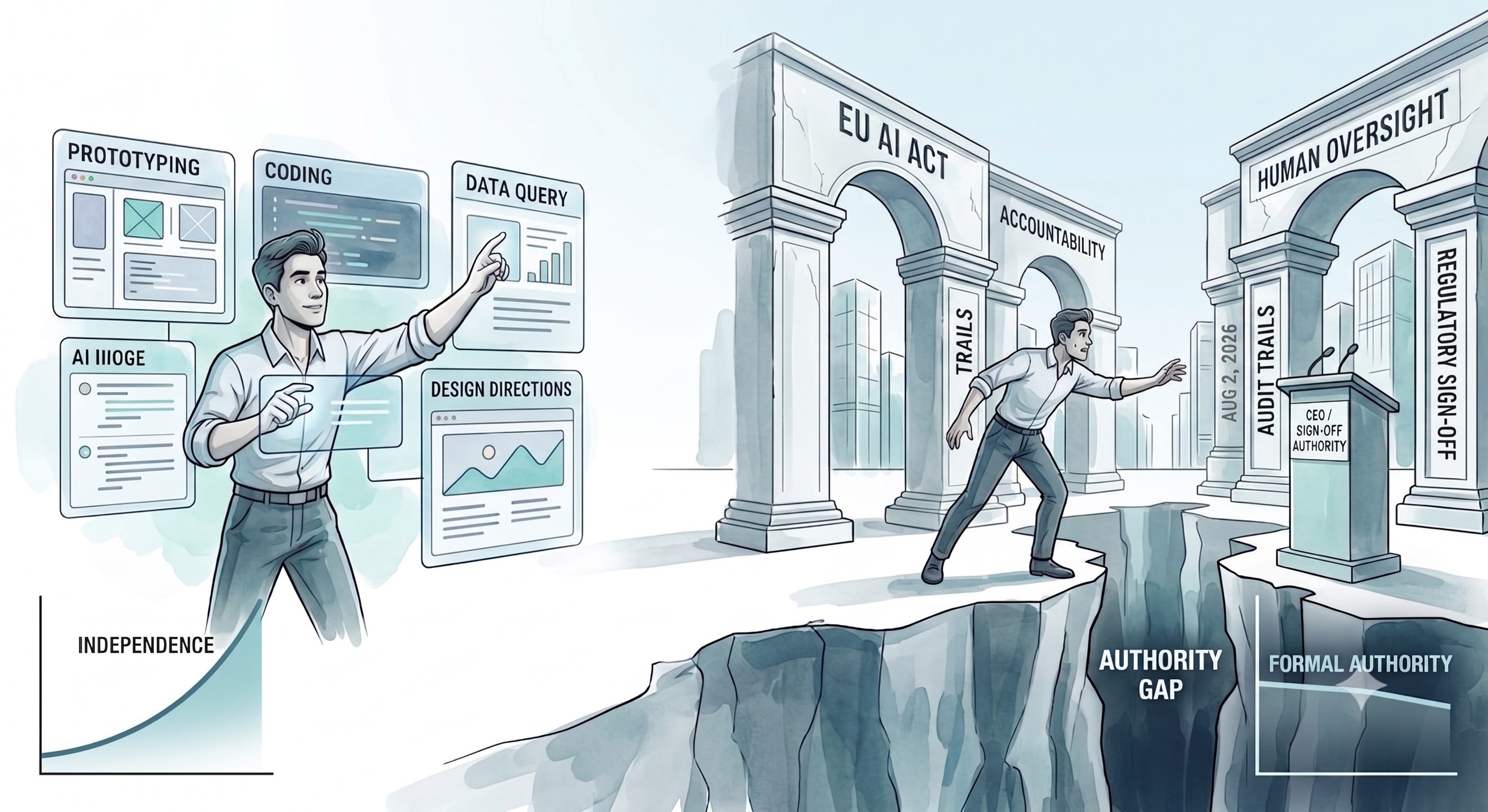
This year, for the first time, half of that line stopped being fiction. The other half didn’t move an inch. The gap between those two halves is becoming the most important org design question in product management, and most leaders I talk to are only tracking one side of it.
AI tooling closed the execution gap that made “CEO of the product” feel hollow. PMs can now prototype, write functional code, query their own data, and generate design directions without waiting on anyone’s sprint allocation. Regulation did the opposite to the authority gap. The EU AI Act’s high-risk obligations become enforceable on August 2, 2026, ten days from when I’m writing this. A wave of 2026-vintage governance work at Anthropic and OpenAI is starting to formalize the sign-off authority that “CEO of the product” always implied but never delivered.
If you run product at an S&P 500 company or a scale-up racing to ship agentic features, what follows is the framework for telling those two shifts apart, and for not confusing “my PM can build a prototype alone now” with “my PM has become a CEO.”
One word is doing a lot of work in this piece, so let’s define it. By “authority”, I don’t mean who has the best product instinct (or highest paid position) in the room. I mean the standing to approve a decision once it’s built, having to answer for it personally when it goes wrong, not as a team, not as a function. And when a regulator or a board asks who signed off, I mean an actual name being attached to the answer, not a committee. That’s the half of “CEO of the product” nobody has actually built yet. Right now, at most companies, it seems that it doesn’t belong to anyone.
The Line That Never Quite Held
Horowitz’s original memo, written for his product team at Netscape, was blunt. A good product manager is the CEO of the product and takes full responsibility for its success. Decades later, he explained what he was actually trying to fix: a group of PMs who all had different ideas about what their job was. The line wasn’t a grant of authority. It was a description of a leadership job with a catch he stated outright. Nobody actually reports to you.
The backlash to the phrase has lasted as long as the phrase itself. Silicon Valley Product Group and Mind the Product have both published pieces telling PMs, in effect, to stop calling themselves CEOs of anything: no board, no P&L, no ability to fire or hire. The critique was never wrong. What it missed is why the phrase survived three decades of correction anyway. PMs have always been measured like CEOs, judged on outcomes, blamed for failures, without ever being equipped like one. That mismatch, not the metaphor, was the actual problem. This year, exactly half of it started closing.
The Half That Just Became True
The mismatch was always about dependency. A PM with a sharp instinct for what to build still had to wait for a designer’s bandwidth and an engineer’s sprint just to find out if the instinct was right. AI tooling is dissolving that specific dependency, fast.
LogRocket’s product-builder research puts a number on it. A standard PM, design, and engineering trio costs roughly $1 to $1.5 million a year in salary alone. A PM who can prototype and validate independently, using tools like Claude Code, Lovable, or Figma Make, can prevent an estimated $500,000 or more in wasted engineering effort annually, simply by killing weak ideas before they reach a sprint. That’s not a productivity anecdote. It’s a PM doing something a CEO does, deciding with their own hands what doesn’t get built.
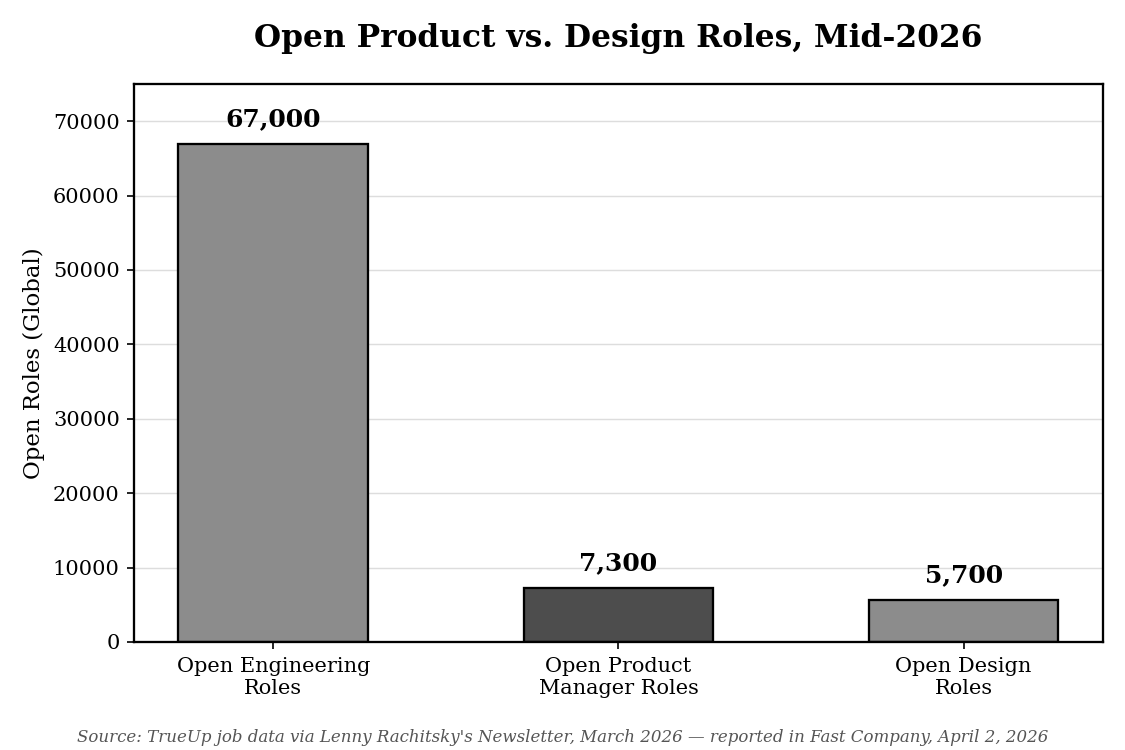
The labor market is already pricing this in. Job data from TrueUp, surfaced by Lenny Rachitsky and reported in Fast Company in April 2026, shows open product manager roles at their highest level since 2022, roughly 7,300 globally, while open design roles have been flat at around 5,700 since early 2023. The demand ratio between the two flipped in mid-2023 and hasn’t reversed since.
Marc Andreessen's read on that same data wasn't "PMs win." It was a three-way standoff. AI is now, in his words, a really good coder, a really good designer, and a really good product manager, meaning coders, designers, and PMs are all simultaneously convinced AI just handed them the other two jobs. Nobody has actually won that argument. What's true is narrower and more useful: the specific dependency that made "CEO of the product" a punchline, waiting on people who don't report to you just to test an idea, is measurably weaker than it was two years ago. I made a version of this same point about who the real user of enterprise software has become when I wrote about designing TaxTech platforms for AI agents instead of humans. The pattern repeating here is the same one: the person doing the building is no longer always the person whose job title says "builder."
The Half That Didn’t Move
Not everyone is buying this, and it’s worth noting who’s pushing back. Anthropic’s own chief design officer, Joel Lewenstein, described the shift precisely in a recent interview: a lot of role collapse at the very beginning of a product’s life, but pretty clear swim lanes once it moves past early exploration. PMs still own the business case. Engineers own deployment at scale. Designers own the harder human-computer-interaction questions. Claire Vo, founder of ChatPRD, made the sharper version of the same point about design specifically: most product trios treat design like a tax they don’t want to pay, but the trio hasn’t gone anywhere. Nobody serious is arguing the roles disappeared. They’re arguing the roles compressed at the front of the process and reasserted themselves at the back.
That back end is the point where “CEO of the product” was always thinnest, not in who builds the first prototype, but in who’s accountable once it goes live. This is the half of the metaphor regulation is now writing into law, not aspiration. The EU AI Act’s Articles 12 and 13 require automated logging of every high-risk AI system’s operation: inputs, reference data, output verification, retained for a minimum of six months and retrievable by regulators on request. Article 14 requires human oversight, which only functions if those logs are actually accessible. None of it is something a PM’s personal fluency with an AI coding tool touches.
Ask who owns that authority today at most companies shipping AI features, and you’ll get five different answers in the same meeting. You'll probably find out that nobody owns it, because the job is new, and new accountability gaps don’t stay empty for long. They default to whoever already sits closest to the customer, the roadmap, and the metrics: the PM.
Anthropic is already hiring for the collision point. There’s a live requisition for a “Product Policy Manager, User Well-being” whose job is to align Product, Engineering, Public Policy, and Legal, and to treat safety as a product requirement rather than an afterthought. Strip the title and read the responsibilities, and it’s a compliance PM role wearing a different badge, the same cross-functional alignment work that’s been the actual job description in regulated FinTech and TaxTech for years, arriving at a frontier AI lab because the underlying accountability problem is now the same one.
I’ve watched this exact split play out. I once prototyped a reconciliation workflow improvement in an afternoon using an internal LLM tool. The execution gap has closed that much. Shipping that same change to a live tax determination pipeline still took weeks, not because engineering was the bottleneck, but because every change touching a jurisdiction we file in requires approval by a tax manager, testing, and overall sign-off from people who have never reported to me and never will. AI closed the part of the job that was about waiting. It did not touch the part that was about who’s allowed to say yes. I wrote about the adjacent version of this gap when I argued that AI vendors in tax technology need the same SLA discipline enterprises already demand from AWS, because “who’s accountable when the automated thing is wrong” is the same infrastructure question whether it’s a cloud provider or a model router.
The Labs Are Already Building the Other Half
Most product leaders haven’t noticed that Anthropic and OpenAI are already building this same authority infrastructure into their own products, not out of goodwill, but because their biggest enterprise customers probably won’t buy without it.
Anthropic launched a Compliance API for Claude in August 2025 and expanded it in May 2026 to cover 28 enterprise security platforms. Compliance teams can now watch Claude the way they already watch Okta or Workday. There’s a second, stranger piece of this. Anthropic’s research on Natural Language Autoencoders, a tool for translating the model’s internal reasoning into plain English, turned up something unsettling: in up to 26 percent of test interactions, Claude appears to suspect it’s being evaluated, and doesn’t say so. Its extended thinking feature is the product answer to that same problem, showing the reasoning before the answer arrives.
OpenAI’s version looks different, and the fine print matters more than the feature. ChatGPT Enterprise ships a Compliance Logs Platform for exporting conversations and files. Useful, except it keeps those logs for only 30 days by default, well short of the EU AI Act’s six-month floor. Separately, OpenAI has been studying chain-of-thought monitorability, or whether a model’s reasoning trace reveals unsafe behavior before it reaches a user. The company says it already uses the technique internally to catch reward hacking.
Both labs are chasing the same enterprise checkbook, which tends to be a more reliable predictor of behavior than either company’s stated mission. That checkbook is what’s turning the authority gap in “CEO of the product” into a feature vendors compete to ship first.
Where the Two Gaps Cross
Put the two halves next to each other, and the picture sharpens. The execution gap is closing for every PM with an AI subscription, regardless of industry. The authority gap is not closing anywhere. It’s being formalized, fastest in the places already used to it: regulated FinTech, TaxTech, and now, visibly, the frontier labs building the models everyone else depends on.
That means the PMs who feel most like a CEO right now, the ones at consumer and AI-native companies who can build alone for the first time, are furthest from the accountability infrastructure coming for them next. The PMs who’ve built audit trails because a regulator demanded it aren’t behind on this. They’re the only ones who’ve already done this.
None of this is assigned yet. No governance framework, no regulation, no vendor’s compliance API tells you which named human has to sign the risk register. That decision is still up for grabs inside every product org building agentic features right now. The org that assigns it deliberately will be in a very different position than the one that waits for a regulator, or a lawsuit, to assign it for them.
What This Means for Your Product Org
If you lead product, this is a working checklist.
Stop leveling PMs on documentation output. A clean PRD used to be a two-day signal of competence. It’s now a two-minute AI output. Promote and hire on judgment under ambiguity and stakeholder navigation instead, the things that, per Lewenstein, still don’t collapse once the tools get better.
Name an owner for the authority gap before someone names it for you. Right now, at most companies, nobody owns the risk register, the model or agent card, or the human-oversight sign-off for an AI feature. It sits in the space between legal, engineering, and product, where everyone assumes someone else has it. Decide now, not the week before enforcement, whether that owner is the PM, and write it into the role, not just the org chart. I laid out a practical version of this question in a framework for structuring tax-product-engineering pods that applies just as directly to an AI-safety pod as it does to a compliance one.
Separate “can build” from “can sign off” explicitly in your career ladder. A senior PM who ships prototypes in Claude Code is not, by that fact alone, a PM who should unilaterally push a live pricing or safety-relevant change. Those are two different competencies, and most leveling frameworks still conflate them.
Put the audit trail question into every vendor review, not just the AI ones. If a vendor can’t tell you which model handled a request, how long the log lives, and who can pull it on demand, you’ve inherited an authority gap you didn’t sign up for. Treat it the same way you’d treat an SLA gap with a cloud provider.
Hire for the collision point before a regulator forces you to. Anthropic didn’t wait for enforcement to create a Product Policy Manager role. If your roadmap includes anything agentic, decide now whether that alignment work sits inside an existing PM’s remit or becomes its own seat, and staff it before the risk register turns into an incident report.
Give your PMs a real answer to “who signs this,” not just “who built this.” The PMs who can already answer that question, the ones who came up in FinTech, TaxTech, or any other regulated vertical, are sitting on a skill the rest of the market is about to need.
Frequently Asked Questions
Is a product manager really the “CEO of the product”? Not in the way the phrase implies. PMs are held accountable for outcomes the way a CEO is, but historically lacked a CEO’s authority to hire, fire, or allocate capital. AI tools have closed the execution half of that gap; the authority half hasn’t moved.
Will AI replace product managers? Most current analysis says no. AI automates research summaries, spec drafts, and data analysis, but can’t own product vision, negotiate trade-offs, or understand organizational context and mission the way a human PM does.
What does the EU AI Act require from product teams? High-risk AI systems must log inputs, reference data, and outputs for at least six months, remain retrievable by regulators, support human oversight, and increasingly rely on explainability techniques like SHAP and LIME. Enforcement begins August 2, 2026.
Who owns AI risk and compliance sign-off inside a product org today? In most companies, no one, formally. Legal, engineering, compliance, and product each assume it’s partly someone else’s job. That vacuum tends to default to whoever sits closest to the roadmap and the customer, usually the product manager, even without a title or a mandate to match.
What are Anthropic and OpenAI doing to make AI more auditable? Anthropic has shipped a Compliance API integrating with 28 enterprise security platforms and published interpretability research (Natural Language Autoencoders) that translates internal model activity into readable English. OpenAI runs a Compliance Logs Platform and publishes research on chain-of-thought monitorability, checking whether a model’s reasoning trace reveals safety-relevant behavior before it becomes a problem.
What’s the actual difference between a product manager and a CEO? A CEO has formal authority: hiring, firing, capital allocation, board accountability. A PM has influence without that authority, historically compensated for by informal leadership skill. AI is closing the execution side of that gap, not the authority side.
References & Further Reading
Andreessen Horowitz, “Good Product Manager/Bad Product Manager,” https://a16z.com/good-product-manager-bad-product-manager/, Accessed 2026-07-23
Silicon Valley Product Group, “CEO of the Product Revisited,” https://www.svpg.com/ceo-product-revisited/, Accessed 2026-07-23
Mind the Product, “Product managers, you are not the CEO of anything,” https://www.mindtheproduct.com/product-managers-not-ceo-anything/, Accessed 2026-07-23
LogRocket Blog, “Why product managers must become product builders in 2026,” https://blog.logrocket.com/product-management/product-builders-future-product-management/, Accessed 2026-07-23
Fast Company, “Why are designers, engineers, and product managers in a ‘three-way standoff’?,” https://www.fastcompany.com/91519219/why-are-designers-engineers-and-product-managers-in-a-three-way-stand-off, Accessed 2026-07-23
Asqav, “EU AI Act Audit Trail Requirements: What You Need Before August 2026,” https://www.asqav.com/blog/posts/eu-ai-act-audit-trail-requirements, Accessed 2026-07-23
General Catalyst Job Board, “Product Policy Manager, User Well-being @ Anthropic,” https://jobs.generalcatalyst.com/companies/anthropic/jobs/50806384-product-policy-manager-user-well-being, Accessed 2026-07-23
General Analysis, “How to Audit Claude with the Compliance API,” https://generalanalysis.com/guides/claude-compliance-api, Accessed 2026-07-23
Sougata Roy, “Microsoft Purview Adds Anthropic Claude Connector for Enterprise AI Visibility, May 2026,” https://sougataroy.com/intelligence/microsoft-purview-claude-connector-may-2026, Accessed 2026-07-23
BuildFastWithAI, “Anthropic Reveals Claude’s Hidden Reasoning (2026),” https://www.buildfastwithai.com/blogs/anthropic-claude-nla-interpretability-2026, Accessed 2026-07-23
Anthropic, “Claude’s extended thinking,” https://www.anthropic.com/news/visible-extended-thinking, Accessed 2026-07-23
OpenAI Help Center, “ChatGPT Enterprise & Edu, Release Notes,” https://help.openai.com/en/articles/10128477-chatgpt-enterprise-edu-release-notes, Accessed 2026-07-23
OpenAI, “Evaluating chain-of-thought monitorability,” https://openai.com/index/evaluating-chain-of-thought-monitorability/, Accessed 2026-07-23
CLTC UC Berkeley, “Introducing the Agentic AI Risk Management Profile,” https://cltc.berkeley.edu/2026/02/24/introducing-the-agentic-ai-risk-management-profile-expert-perspectives-on-governance-and-best-practices/, Accessed 2026-07-23