

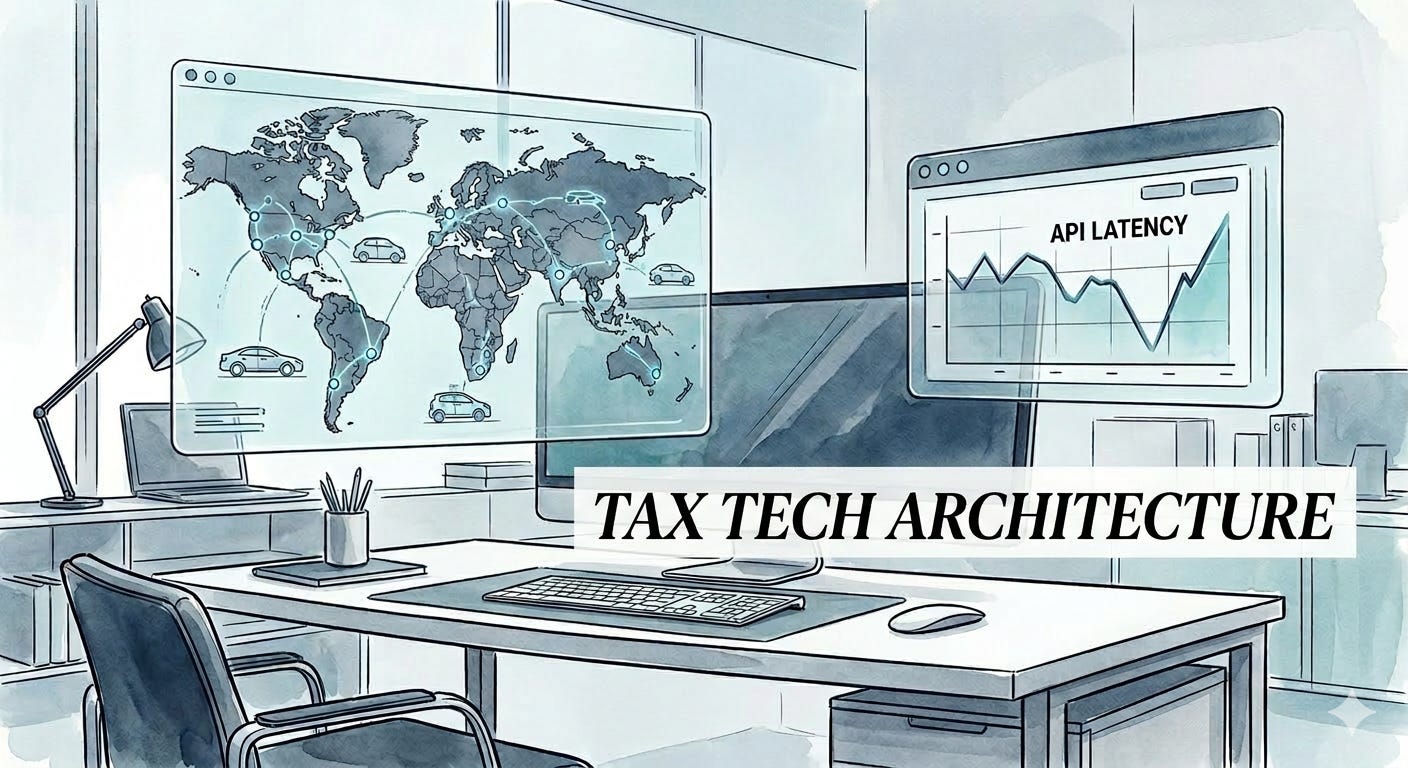
In the world of S&P 500 scale and high-growth scale-ups, the line between “Tax Compliance” and “Revenue Operations” has officially vanished.
We’ve entered the era of Continuous Transaction Controls (CTC). In this world, tax determination isn’t a monthly reconciliation task; it is a live dependency baked into your checkout flow.
The Hidden Risk: Compliance as a Single Point of Failure
The stakes in 2026 are binary. If the API to a tax authority hangs for 5 seconds, your checkout hangs for 5 seconds. In the mobility world, 5 seconds is an eternity—it is the difference between a completed ride and a frustrated user switching to a competitor.
If your data is flawed or your integration is “brittle,” your transactions won’t just be misreported; they will fail to complete entirely. You haven’t just added a compliance step; you’ve added a single point of failure to your revenue stream.
Based on my experience at Uber, here is how you move to a resilient, product-led tax infrastructure:
1️⃣ Robust, Real-Time Calculation: Your tax engine must handle complex logic—location-based rules, exemptions, and thresholds—in milliseconds. If your calculation can’t keep pace with a high-concurrency order service, your architecture is already broken.
2️⃣ Asynchronous Orchestration: Does the transaction move forward while the tax validation runs in a prioritized queue? Or is the user staring at a loading spinner? Build your user flows with contingency in mind. At Uber, we prioritize the user experience while ensuring the tax logic catches up in parallel.
3️⃣ Continuous Data Quality (DQ) Checks: Don’t wait for an audit to find a schema drift. Schedule automated DQ checks to catch mapping errors before the data ever hits a tax authority. At Uber, data points are checked continuously against external databases to ensure success before the API call.
4️⃣ The “Offline Mode” Fallback: What happens when a government server goes dark? You need fallback logic that preserves data integrity without killing the UX. Invest in smart retry mechanisms. At Uber, we invest a lot in smart retry mechanisms. Nothing else will scale in this case.
5️⃣ Agentic Troubleshooting: Manual troubleshooting is the silent killer of the S&P 500. When a document fails, you need an AI Agent that can trace the error, suggest the fix, and re-trigger the submission. This is a deterministic task—perfect for AI agents, not for your high-priced tax team.
“In a CTC world, Tax is no longer a ‘To-Do’ list for the back office; it is a live API dependency for the business operations. If your tax stack isn’t as resilient as your payment gateway, you aren’t just at risk of an audit—you’re at risk of revenue leakage.” 🏃

The Takeaway for Leaders: Your goal is to build tax technology that never blocks business operations. Is your tax logic a standalone project, or is it baked into your product roadmap?
Stop treating Tax as a project. Start treating it as a Product.
Sources:
OECD Guidance: Digital Continuous Transactional Reporting (DCTR) for VAT
Fonoa Blog: Real-Time Reporting and the Shift to CTC
Deloitte Insights: Strategic Moves: Navigating the Age of Agentic AI
Vertex Resources: Overcoming SAP S/4HANA & E-Invoicing Challenges
VATupdate: Daily Global VAT & CTC News