

Last year I sat in a vendor demo for a new indirect tax platform. The sales engineer spent more than 45 minutes walking us through the UI (an arduous ordeal, if you ask me). The dashboard was beautiful. Someone had spent months (or years) making this thing look exactly right.
Halfway through, I thought, “I wonder how many times a day actual humans will open this interface…”
At Uber, our tax determination and external integrations services and APIs are called millions of times a day. The overwhelming majority of those calls come from other services and automated pipelines — not from a tax professional navigating a dashboard, not from anyone sitting at a keyboard. The interface we were presented with was designed almost exclusively for a user who increasingly doesn’t and won’t show up. The product looked like it was built for the 1%. The 99% didn’t actually need a UI.
That conversation keeps coming back to me. Because I don’t think Uber is the exception. I think we’re the industry.
The Wrong User
Most products in enterprise TaxTech over the last decade look like they were optimized for a human sitting at a keyboard. Navigation menus, approval buttons, dashboard layouts. This wasn’t wrong — it was right for its time. We built what the market needed. The market just changed faster than our roadmaps did.
I wrote earlier this year about why tax teams need to stop being compliance factories and become AI orchestrators. That was about the people side. This post is about the product side because it’s where most teams have to start now.
IDC published something blunt in May 2026: “AI agents don’t care about your UI. They don’t appreciate an elegant dashboard or a well-designed navigation menu. What they need is data access, API depth, and integration reliability.”
That’s not a trend piece. That’s a verdict on a decade of product decisions.
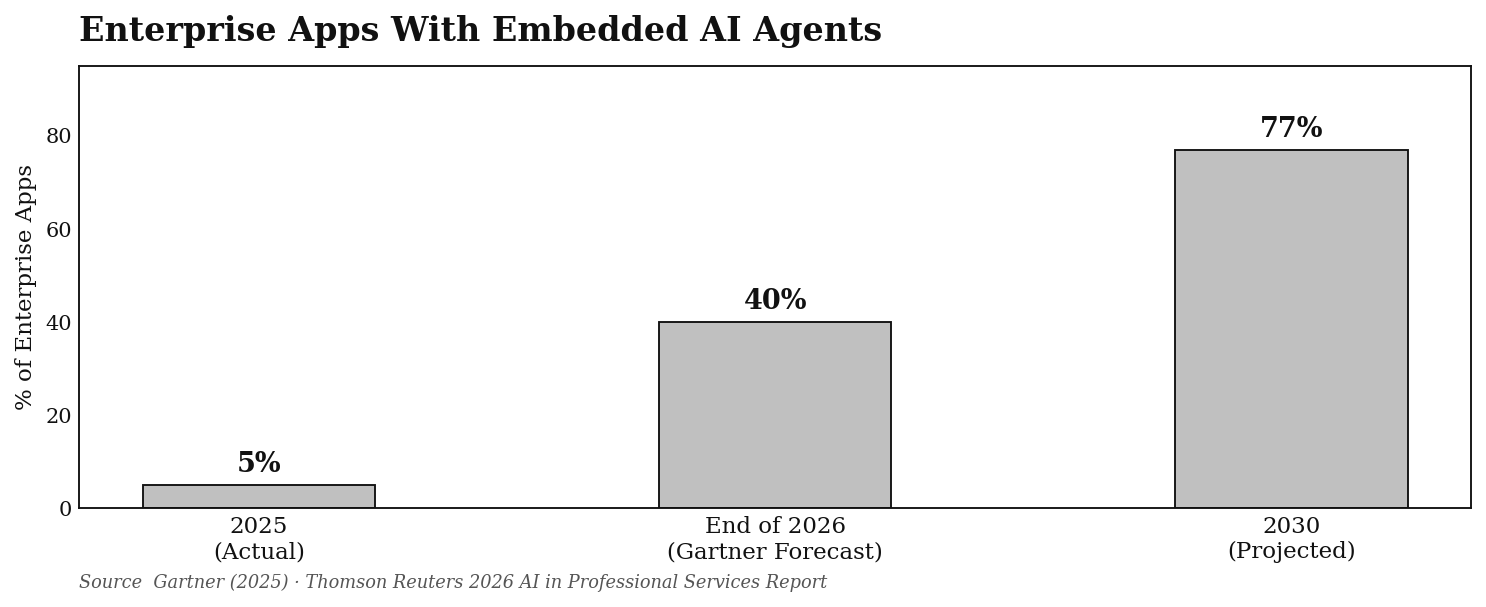
Gartner projects 40% of enterprise apps will embed AI agents by the end of 2026 — up from less than 5% in 2025:
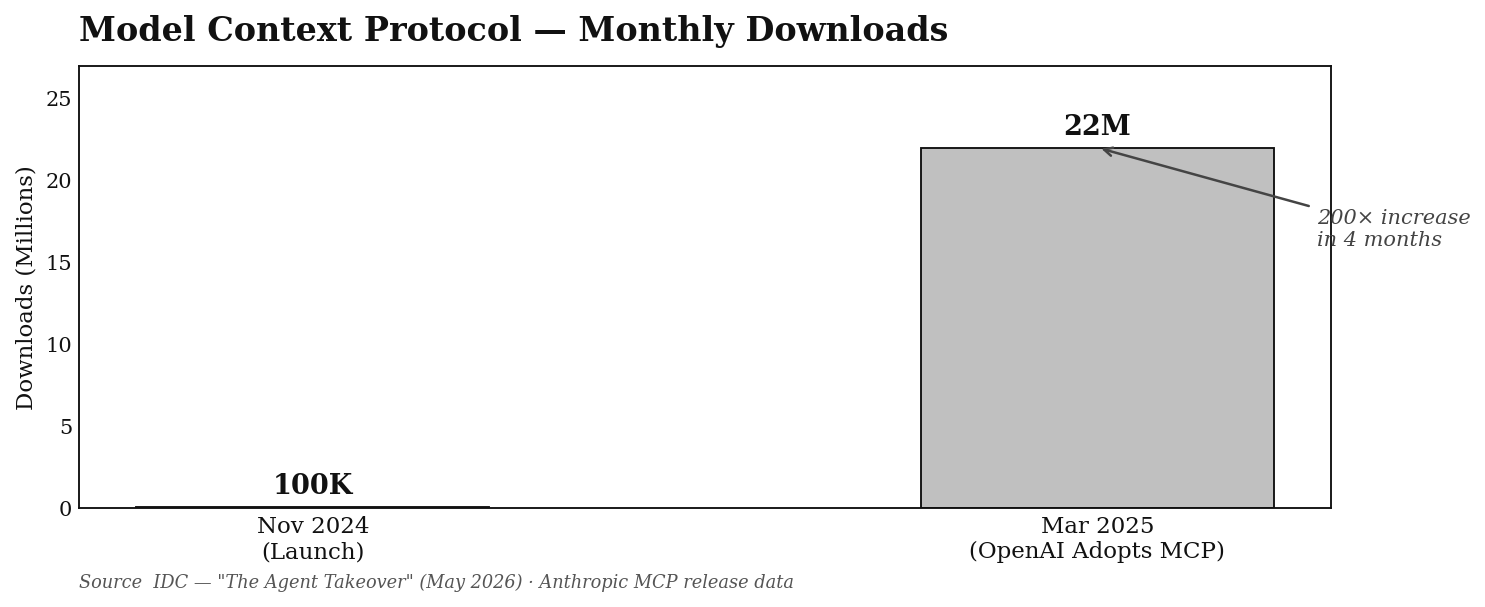
When Anthropic launched the Model Context Protocol in November 2024, it hit 100,000 downloads in a month. When OpenAI adopted it in March 2025, that jumped to 22 million monthly downloads within weeks (a two-hundredfold increase in four months, or the time between your last roadmap review and your next one).
The UX moat we spent years building is gone. The new moat is API depth, clean data models, and MCP compatibility. The TaxTech PM who doesn’t make this call in 2026 will make it reactively in 2027, under worse conditions and likely severe competitive pressure.
Three Paths
I think there are three ways an AI agent will interact with your product (in this order):
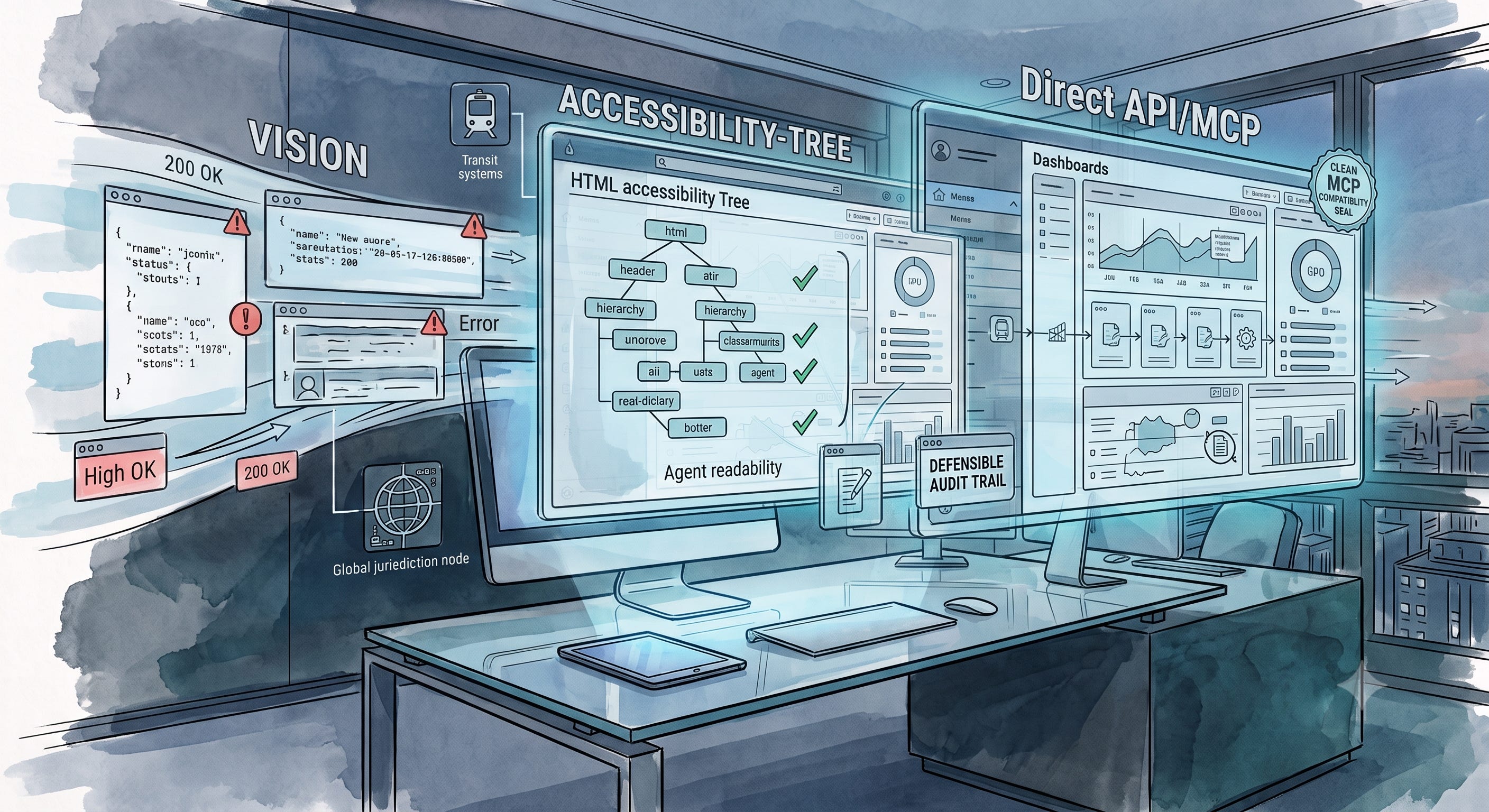
1️⃣ Vision-based parsing — the agent screenshots your interface and infers what’s on screen. This is usually slow, error-prone, and token-heavy. This is what happens when there is no other option. If your product is only reachable this way, agents will fail on it constantly and silently. Most websites are not yet optimized for image-based reading.
2️⃣ Accessibility-tree parsing — the agent reads the structured HTML representation your browser generates. Faster and more reliable. Nielsen Norman Group made the business case in April 2026: products built with strong accessibility practices are already more legible to agents. The teams that invested in semantic HTML, proper labeling, and logical page structure were accidentally preparing for this.
3️⃣ Direct API or MCP calls — the agent bypasses the UI entirely. Clean contracts. Structured responses. Machine-readable outputs. No screenshots, no inference, no ambiguity.
For TaxTech, only the third option scales because VAT determination, e-invoicing reconciliation, and transfer pricing run at transaction volume, not human speed. An agent calling your tax engine doesn’t need a beautiful UI. It needs a contract it can trust: predictable inputs, deterministic outputs, versioned endpoints, and error states that explain exactly what broke in terms a downstream system can act on.
Where This Gets Dangerous
This is the part most agentic AI pieces skip. I will clarify.
In most software categories, going agent-first is an architecture problem. In compliance, it’s an architecture problem and a liability problem. Thomson Reuters framed it well in June 2026: “AI that produces a correct result through an opaque process is not useful in a compliance context. It’s a liability. Auditors don’t just want the answer — they need a full trail of evidence showing exactly who reviewed what, when, what changes were made, and what rationale was applied at each decision point.”
This matters more than most PM frameworks acknowledge. And it’s getting more urgent: the IRS now runs 126 AI applications. Your auditor isn’t a person reviewing PDFs anymore. Your audit trail needs to be as machine-readable as the system now reviewing it.
In a consumer app, an agent making the wrong call is a bug report. In indirect tax, it’s a penalty notice, an audit trigger, or a blocked filing in a jurisdiction your business depends on. The stakes are not the same. The architecture cannot be the same.
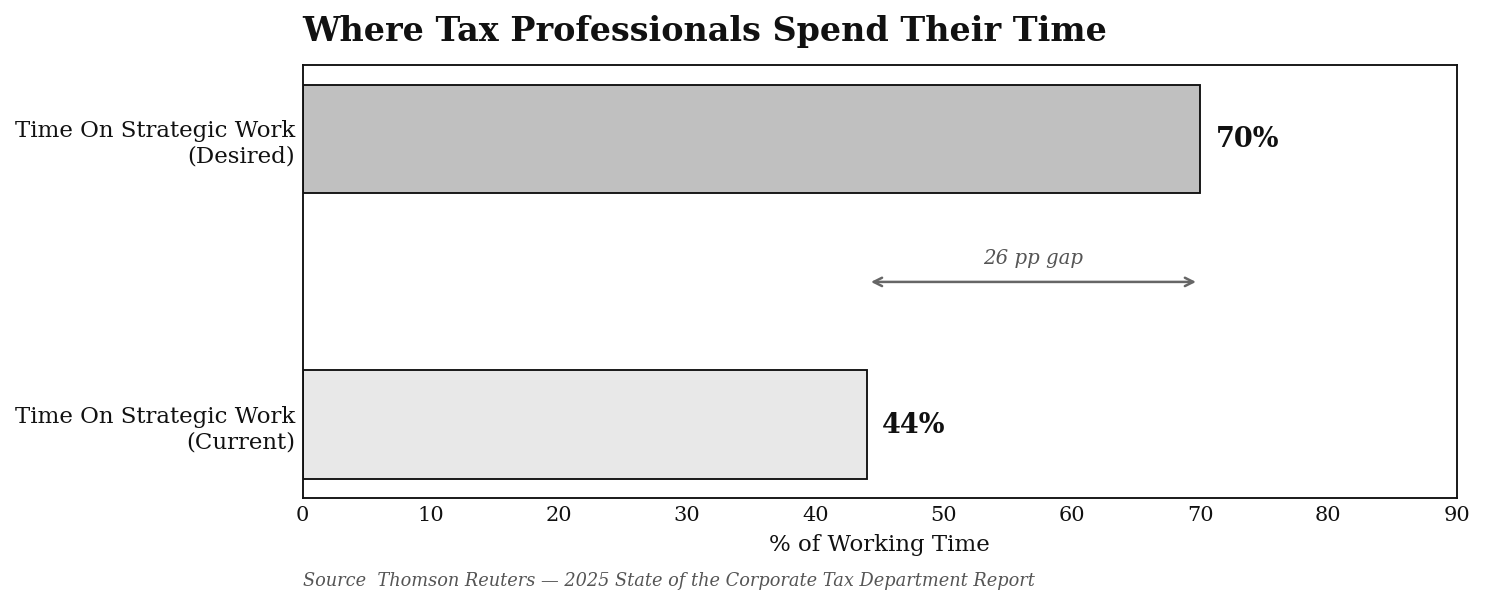
And here’s the number that should make every tax director uncomfortable: 56% of a tax professional’s working day goes to reactive, manual tasks. They want to spend 70% of their time on strategic work. The gap between where they are and where they want to be is exactly the gap that agentic TaxTech is supposed to close. But only if the product is built for the agent doing the work — not the human watching it happen.
On the one hand, we are asking tax teams to do more with less, across more jurisdictions and on tighter timelines. On the other, we are building products optimized for a user interaction pattern that doesn’t scale and wouldn’t support those teams. I imagine most tax folks would be frustrated. I am.
How To Build For The Right User
The old product design process: define user stories for a tax professional navigating a workflow → design the UI → build the backend to serve the UI.
The new one: define the agent contract first. What does an orchestration layer need to call your product reliably? What structured response does it need back? Then build the human interface as a governance layer on top of that contract, not as the primary interaction surface.
In practice, five steps:
1️⃣ API-first, without compromise. Every capability must be accessible programmatically before it ships in a UI. If it can’t be called by a machine, it isn’t ready. This discipline was optional during the decade of dashboard-first SaaS growth. It is not optional now.
2️⃣ Your MCP server is a product deliverable, not a dev tool. If you’re building or buying a TaxTech platform in 2026 without a clear answer to “how will external agents call this?”, you’re betting on the wrong product. Treat your MCP surface area with the same rigor as your UI.
3️⃣ Redesign your output contracts. Agents don’t need a PDF summary of a VAT reconciliation. They need a structured JSON object: clear field definitions, status codes, confidence levels where applicable, and error states that explain exactly what broke and why. If your outputs are designed to be read by a human, they’re the wrong outputs.
4️⃣ Draw the architectural line explicitly. AI reasoning handles classification, routing, and anomaly detection. Deterministic logic handles tax calculation, rate application, and filing validation. Make that boundary visible in your documentation, data model, and audit trail.
5️⃣ Redesign the UI for governance, not navigation. If most of your product’s interactions come from agents, the human interface is a control room, not a workflow tool. Approval queues. Exception dashboards. Audit trail viewers. Threshold alerts. That’s what a tax director actually needs from a screen in an agentic world. The navigation menu that dominated your last three sprints? It’s infrastructure now.
For more on how the TaxTech vendor landscape is repositioning around these decisions, I mapped the field in The 2026 AI TaxTech Map (worth reading alongside this).
The Thing Nobody Says Out Loud
Everyone can build agents now. LLM APIs, no-code platforms, an autonomous workflow shipped by someone who’s never shipped before. Role definitions are dissolving, and almost nobody is asking the architecture question first. In a consumer app, that produces useful experiments. In compliance, it produces something different: fast-moving systems that are confidently wrong before anyone notices.
The fix isn’t to slow down. It’s to define the contracts before you release the velocity. Who owns the tax calculation layer? What is an agent explicitly not permitted to do without a human gate?
Here’s the diagnostic I’d run if I were auditing a TaxTech product today: can an external AI agent call your core tax determination capability right now — with a structured input, a deterministic output, a versioned contract, and a full audit trail of what the agent did and why? If the answer is no, you’re not behind on AI. You’re behind on the architecture that makes AI safe to use in your domain.



Frequently Asked Questions
What is agent-first product design in TaxTech? It means building TaxTech products where the primary interaction surface is a programmatic API or an MCP server — not a human-facing UI. The product is designed so that AI agents can reliably call it, receive structured outputs, and operate within defined governance boundaries without a human having to navigate the interface at each step.
What is agentic AI in tax compliance? Agentic AI in tax compliance refers to AI systems that autonomously orchestrate multi-step workflows — pulling data from ERPs, performing tax calculations, validating against e-invoicing records, and generating filing-ready outputs — without requiring a human to manually execute each step. The key difference from earlier AI tools is that the agent determines its next action based on intermediate results.
What are the risks of AI agents in tax compliance? The primary risks are audit exposure due to opaque decision-making, compounding errors from agents operating at scale without human review, and compliance failures arising from applying probabilistic AI reasoning to deterministic calculations. The mitigation is a governance architecture comprising audit trails, deterministic calculation engines, and mandatory human-review gates at material decision points.
What governance is required for AI agents in regulated industries? At a minimum: a full audit trail of every agent action (inputs, logic applied, output, reviewer, timestamp), a hard separation between AI-assisted orchestration and deterministic calculation logic, mandatory human review gates at material decision points, and versioned API contracts that make agent behavior reproducible and auditable.
What is MCP and why does it matter for TaxTech? The Model Context Protocol is an open standard — introduced by Anthropic in November 2024 and adopted by OpenAI in March 2025 — that defines how AI agents communicate with enterprise software. For TaxTech, it means agents can call your tax engine, reconciliation tools, or e-invoicing platform directly, without screen scraping or custom integrations. Vendors with MCP-compatible surfaces are the ones enterprise orchestration layers will choose to call.
References & Further Reading
IDC (Eric Newmark) — “The Agent Takeover: What Happens When AI Becomes the Primary User of Enterprise Software“ — May 14, 2026
Nielsen Norman Group (Sarah Gibbons & Kate Moran) — “AI Agents as Users“ — April 10, 2026
Thomson Reuters — “Is your tax department ready for the agentic AI explosion?“ — June 8, 2026
Thomson Reuters — “Expert-first vs. AI-first tax compliance“ — 2026
Gartner — “Gartner Predicts 40% of Enterprise Apps Will Feature Task-Specific AI Agents by 2026“ — 2025
Anthropic — “Introducing the Model Context Protocol“ — November 2024