


Some S&P 500 CFOs and Chief Tax Officers may take the obvious path, treating AI as a procurement exercise: buy the license, schedule mandatory training, set KPIs for usage, and wait for ROI. After all, this approach worked for other challenges, such as e-invoicing or the adoption of last year’s new accounting/tax software.
It won’t come. At Uber, I’ve seen that you cannot bridge the 2026 “fluency gap” with a three-month seminar. Nor with mandatory usage metrics.
Your team must start treating AI not as a novel luxury or a good-to-know skill but as a baseline utility. To capture the 40-60% cycle-time gains for complex reconciliations and tax modeling, as noted in this Deloitte report, you need to anchor your strategy in “AI-natives”— practitioners who bring a “Product Heart” to the “Compliance Brain.”
The Market Mandate for AI-Native Fin/TaxTech Talent
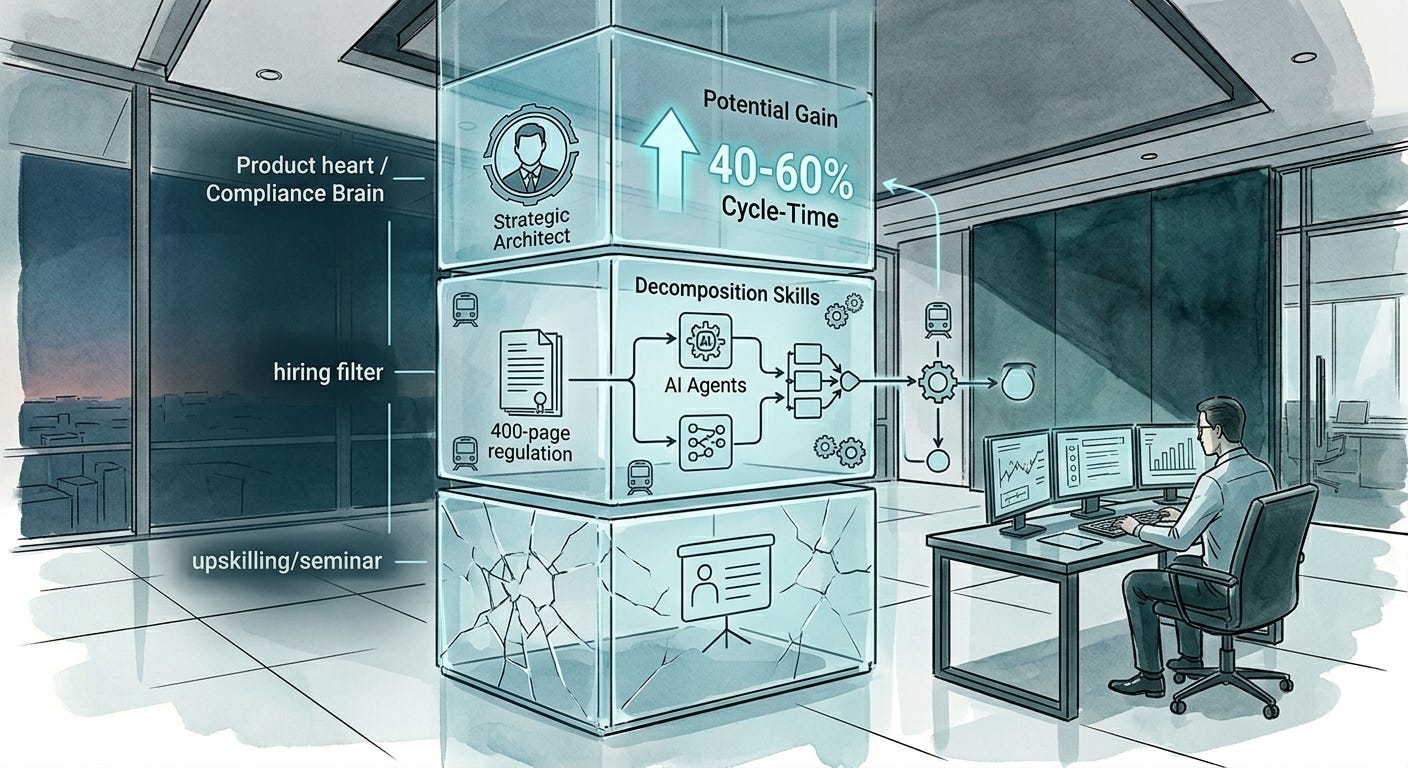
The industry standard has shifted. My analysis of more than 100 current openings across the S&P 500, high-growth scale-ups such as OpenAI, Anthropic, and Lovable, the Big Four, and traditional SaaS vendors such as Xero, Intuit, and Brex reveals that leading firms are bypassing the “training phase” and hiring for AI fluency as a day-one prerequisite.
We are seeing a structural shift in the “Tax/FinTech Lead” role. In other words, there are new capabilities and requirements being sought for high-stakes transformations:
OpenAI is recruiting a Tax Technology Lead to design tax as a “Production System,” integrating compliance directly into core product infrastructure.
PwC has shifted from “upskilling” to hiring AI-Native Engineering Leads who must demonstrate daily proficiency with AI coding assistants.
Intuit is aggressively hiring for AI Workforce Transformation to lead the shift toward AI-first developer velocity.
Anthropic and Lovable are seeking AI-native operators who use agentic workflows to handle real-time Finance & BI decision velocity.
EY and Grant Thornton are targeting Tax Automation & AI Managers to build “AI-enabled solutions” for global VAT and indirect tax reporting.
The Takeaway: these roles do not mention “willingness to learn.” They demand “decomposition skills”— the ability to take a messy 400-page tax regulation and break it down into a deterministic logic flow that an AI agent can execute.
So, what do you need to do?
The FinTax AI Fluency & Hiring Rubric

To move your organization from “pro forma” adoption to “front-line” efficiency, you need to update your hiring rubric. Here is Zapier’s hiring rubric, designed to bring AI-native talent in-house with every hiring decision. It’s a good example.
Here is what a Fin/TaxTech hiring rubric may look like, along with examples of the expected behavior, potential gain, and hiring filter questions to ask:
Stage 1: The Consumer (Passive Use)
Behavior: Using public LLMs to summarize tax memos.
Potential Gain: 5-10% productivity lift on administrative tasks and gross time savings of ~5 hours per week.
Hiring Filter: Ask: "Explain the difference between an LLM and a database." If they view AI as a "search engine" rather than an "execution engine," they are liable for hallucinations.
Stage 2: The Auditor (Problem Decomposition)
Behavior: Reviewing AI-generated reconciliations. They understand the “why” behind the logic.
Potential Gain: 20-30% reduction in manual review time and a 15-25% reduction in manual errors.
Hiring Filter: Ask them to decompose a complex tax problem into prompts. If they can’t break down the workflow, they can’t create working AI flows.
Stage 3: The Orchestrator (Agentic Design)
Behavior: Designing workflows where AI agents handle the “first mile” (data ingestion) and “last mile” (filing).
Potential Gain: Teams hiring orchestrators see a 3.5x higher ROI than those stuck in “training mode.”
Hiring Filter: Ask: "Walk me through a multi-agent workflow you've designed to automate a high-volume tax workstream. How did you structure the 'human-in-the-loop' intervention points?"
Stage 4: The Architect (Tax Product Lead)
Behavior: Building a reusable logic library for 100+ jurisdictions.
Potential Gain: 40-60% cycle-time reduction on global filings and the ability to launch in new markets in days, not months.
Hiring Filter: Ask: "How would you structure a global tax engine to ensure compliance logic is a 'production system' integrated into the product roadmap, rather than a stand-alone 'to-do' list for the tax team?"
Summary
AI fluency within the Fin/TaxTech function is no longer a specialized skill but a mandatory prerequisite for all S&P 500 and high-growth scale-up finance hires. The traditional roles of the Tax Counsel, Accountant, and Tax Manager are augmented by the roles of the Data Engineer, Tech Architect, and Product Manager.


To scale a FinTech or TaxTech function in 2026, you must stop treating AI as a procurement project and start treating it as a hiring mandate.
The data is clear: S&P 500 leaders who anchor their teams with AI-Native Architects—practitioners who can decompose a 400-page regulation into a deterministic logic flow— are achieving 40-60% cycle-time gains and 3.5x higher ROI. Those who rely on “mandatory training” sessions are merely building a more expensive version of their existing “tech stack prison.”
References & Comprehensive Job Analysis (100+ Openings)
Deloitte, “The State of AI in the Enterprise 2026: Strategy for the S&P 500”, April 2026. deloitte.com/state-of-ai-2026
DualEntry, "AI in Accounting: The Complete 2026 Guide", April 2026.
Market Growth Reports, "Artificial Intelligence in Accounting Market Size and Trends Research [2035]", February 2026.
Thomson Reuters, “2026 Corporate Tax Technology Report: The Rise of Agentic Tax Tech”, March 2026. tax.thomsonreuters.com/corporate-tax-technology-2026
Zapier, “Raising the AI Fluency Bar in Hiring”, March 2026. zapier.com/blog/raising-ai-fluency-bar-in-hiring
PwC, “From Compliance to Intelligence: The 2026 Global Tax Outlook”, February 2026. pwc.com/global-tax-outlook-2026
Microsoft Official Blog: New IDC study shows AI’s real-world ROI (November 1, 2023)
Direct Link to the IDC InfoBrief: The Business Opportunity of AI
OpenAI Careers, Tax Technology Lead, April 2026. openai.com/careers/tax-technology-lead
PwC Careers, AI-Native Engineering Lead, April 2026. jobs.us.pwc.com/ai-native-lead
Intuit Careers, AI Workforce Transformation, March 2026. jobs.intuit.com/ai-workforce
Lovable Careers, Finance & BizOps Strategic Partnerships, April 2026. lovable.dev/careers/finance-bizops
Anthropic Careers, Finance Analytics & BI, April 2026. pitchmeai.com/anthropic-finance
EY Careers, Tax Technology and Operations, February 2026. ey.com/tax-tech-jobs
KPMG Careers, Tax Transformation Specialist, 2026. kpmg.com/tax-transformation