

Let’s start with an uncomfortable admission: most of us talk about AI agents in tax and finance the way teenagers talk about sex — a lot of confident chatter, very little firsthand experience, and a quiet fear of being the last one in the room who hasn’t done it yet.
I’ve sat in the vendor demos. I’ve had the 2 a.m. thought every product person in this space has had: what if the thing I’ve spent a career building is being quietly rebuilt by a model that doesn’t sleep as much as I do?
But I always trust the numbers, not the narrative. So here’s a number instead of a vibe. Inside Anthropic’s Claude Connectors Directory (the list of tools the company has chosen to spend its own scarce engineering time vetting), “Finance and Trading” isn’t a side project for interns. As of July 2026, it’s the single largest category in the entire directory. 57 connectors out of 439. Bigger than Marketing and Sales, Data and Analytics, and Development Tools (the category MCP was created to serve).
Not because tax and finance are easy to automate. It’s one of the least forgiving domains in enterprise software, which is exactly why it’s unsettling that it’s winning. It’s winning because it’s where the money is, and every AI lab chasing enterprise revenue has already done that math.
So I decided to create a map: who’s building what, where the productivity gains are real versus theater, what it costs in tokens and dollars to build the tools that plug into it. If you run tax or finance technology at an S&P 500 company or any company interested in AI (and at this point I don’t see a reason not to be at least curious), treat this as the state-of-the-union of how the AI territory is expanding.
The Convergence Nobody Expected
MCP was Anthropic’s pet project fifteen months ago. In February 2026, Anthropic donated it to the Linux Foundation and co-founded the Agentic AI Foundation with OpenAI and Block with Google, Microsoft, AWS, Cloudflare, and Bloomberg standing behind them like investors.
Five companies that would happily eat each other’s lunch, funding the same connection layer simultaneously. That’s not a group hug but a realization that none of them can afford to be the AI provider whose agent can’t reach a customer’s ERP because the customer standardized on someone else’s protocol. So instead of five incompatible standards, you get one standard and five implementations racing to fill it with the highest-value connectors first.
The Marketplace Map
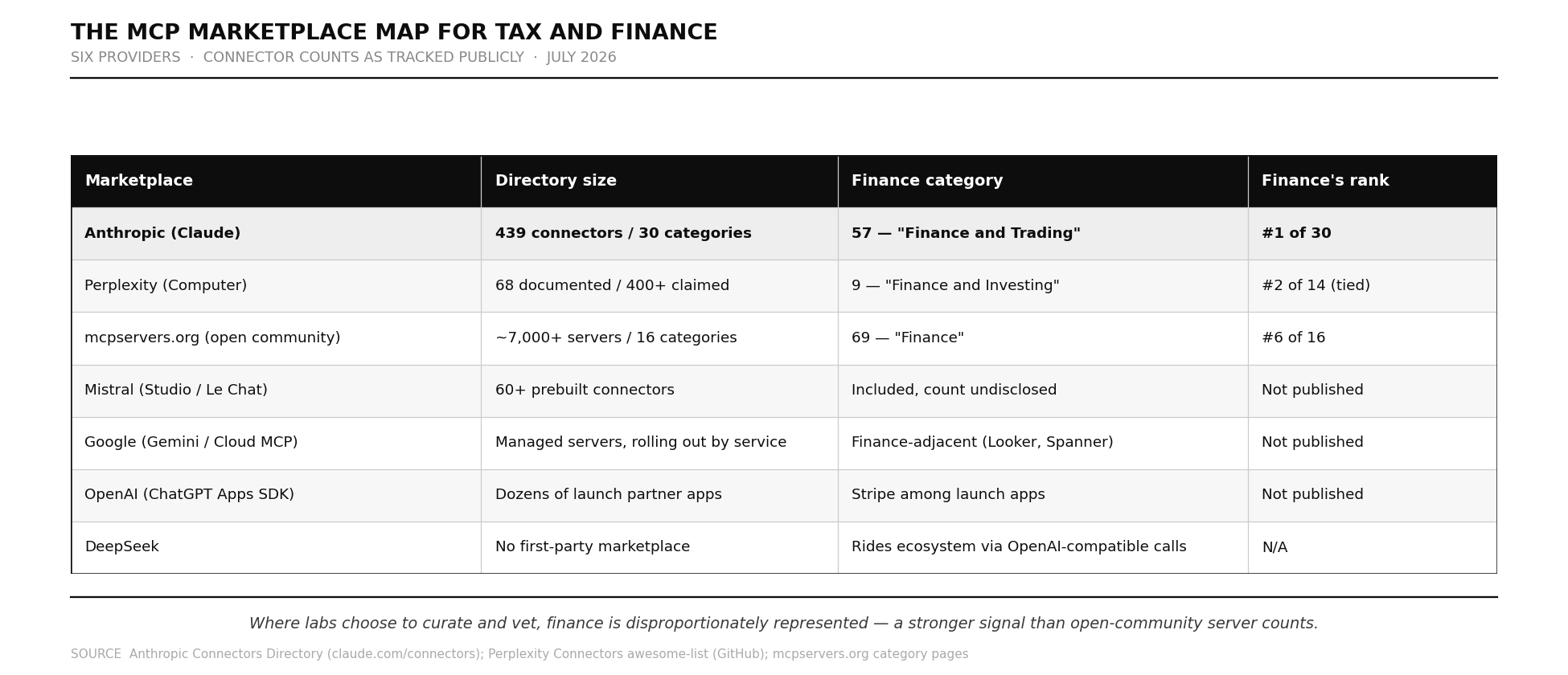
Anthropic — 439 verified connectors, 30 categories, enterprise-managed access via Okta. Perplexity — MCP live on Pro/Max/Enterprise since March, claims 400+ connectors though only 68 have public documentation. Mistral — 60+ prebuilt connectors in Studio and Le Chat, per-workspace admin controls added in June. Google — native MCP in the Gemini API since March, managed servers rolling out service by service. OpenAI — MCP folded into the Apps SDK, “connectors” quietly renamed “apps” in ChatGPT, Stripe among launch partners. DeepSeek — no first-party marketplace at all; V4-Pro rides the existing ecosystem via OpenAI-compatible function calling instead.
The Proof: Where the Curation Effort Goes
Here’s where the “57 connectors” stat gets read backwards. On the open, anyone-can-submit long tail (aggregators like mcpservers.org), finance is a rounding error: development sits at 2,677 servers, productivity at 1,482, finance at 69. MCP is an coding-agent standard, and the open ecosystem still shows it.
But the open directory isn’t where enterprises source tech. What matters is where labs spend their own limited curation effort, deciding what to vet and put their name behind.
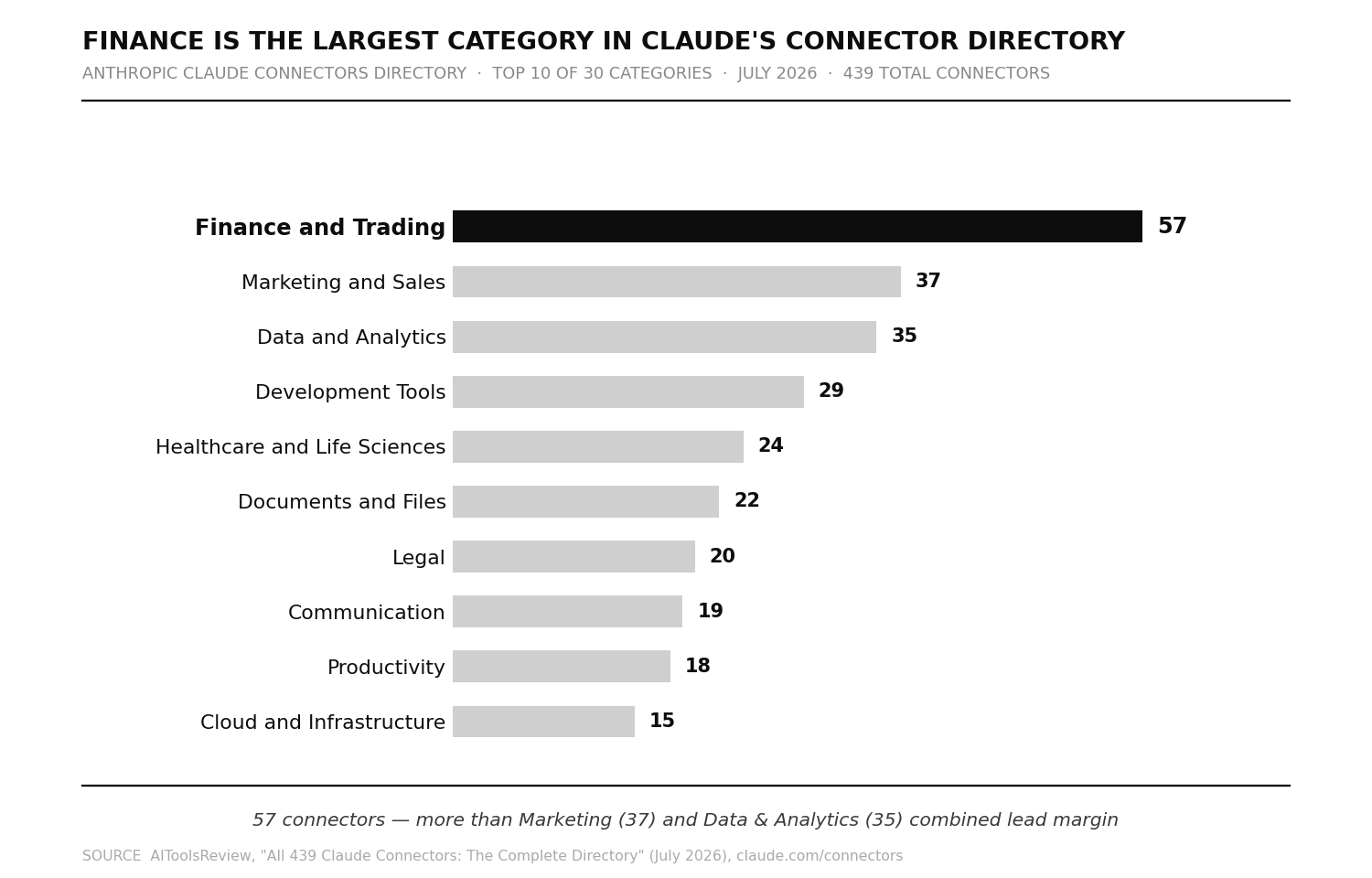
In Anthropic’s vetted directory, Finance and Trading is first: 57 connectors, ahead of Marketing and Sales (37), Data and Analytics (35), and Development Tools (29). In Perplexity’s smaller Computer surface, Finance and Investing ties for second among 14 categories, just behind Healthcare. Two labs, two philosophies, the same independent conclusion. When competitors who’ve never coordinated agree on where the money is, I generally pay attention.
Let’s Check the Hypothesis
Is everyone actually racing to become the everyday interface for Tax and Finance? Yes! But it’s not AI labs versus each other. It’s AI labs and the incumbent ERPs, both sprinting for the same interface layer, using the same neutral protocol as the weapon.
On the AI lab side: Anthropic launched dedicated financial-services agents on May 5, 2026 — reconciliation, valuation review, earnings analysis — wired into Excel, PowerPoint, and Outlook. PwC committed to certifying 30,000 U.S. professionals on Claude. KPMG is integrating Claude into its Digital Gateway for tax and PE clients. That’s a model provider walking straight into the office of the CFO.
The ERPs aren’t ceding ground. SAP is repositioning Joule as the operating layer for an “autonomous enterprise.” Workday shipped agents across HR, IT, and finance. Microsoft used Build 2026 to reframe Windows itself as an agent runtime. Every one of these players is using MCP, or a cousin like Google’s A2A, as connective tissue. Nobody wants to be the vendor locked out of the agent’s reach.
I made a version of this argument in Agent-First TaxTech: Your Tax Platform Was Built for the Wrong User: at Uber’s transaction volume, our tax determination APIs get called millions of times a day, and almost none of those calls come from a human opening a dashboard. MCP just formalized that reality across every vendor relationship at once. The interface war isn’t being fought for the person who opens the app twice a week. It’s being fought for the agent that never sleeps.
Where the Productivity Actually Shows Up
Strip away the platform politics and the case is concrete in a few specific places, not everywhere.
Reconciliation eats roughly 41% of finance teams’ hours today, and production AI deployments are now reporting 95% straight-through cash application. The human exception queue shrinks to a sliver of volume.
Tax preparation shows the cleanest math: ~30 minutes saved per return. At 2,000 returns a year, that’s ~1,000 hours recovered, $15,000–$20,000 in offshore prep cost, freed for review instead of data entry.
Audit and document review is running 50%+ reductions in analysis time at firms that took deployment seriously, which tracks with what I wrote in TaxTech AI Vendors Must Have the Same SLAs You Demand from AWS: gains show up fastest where the data pipeline was already clean, and stall everywhere else.
What This Actually Costs to Run
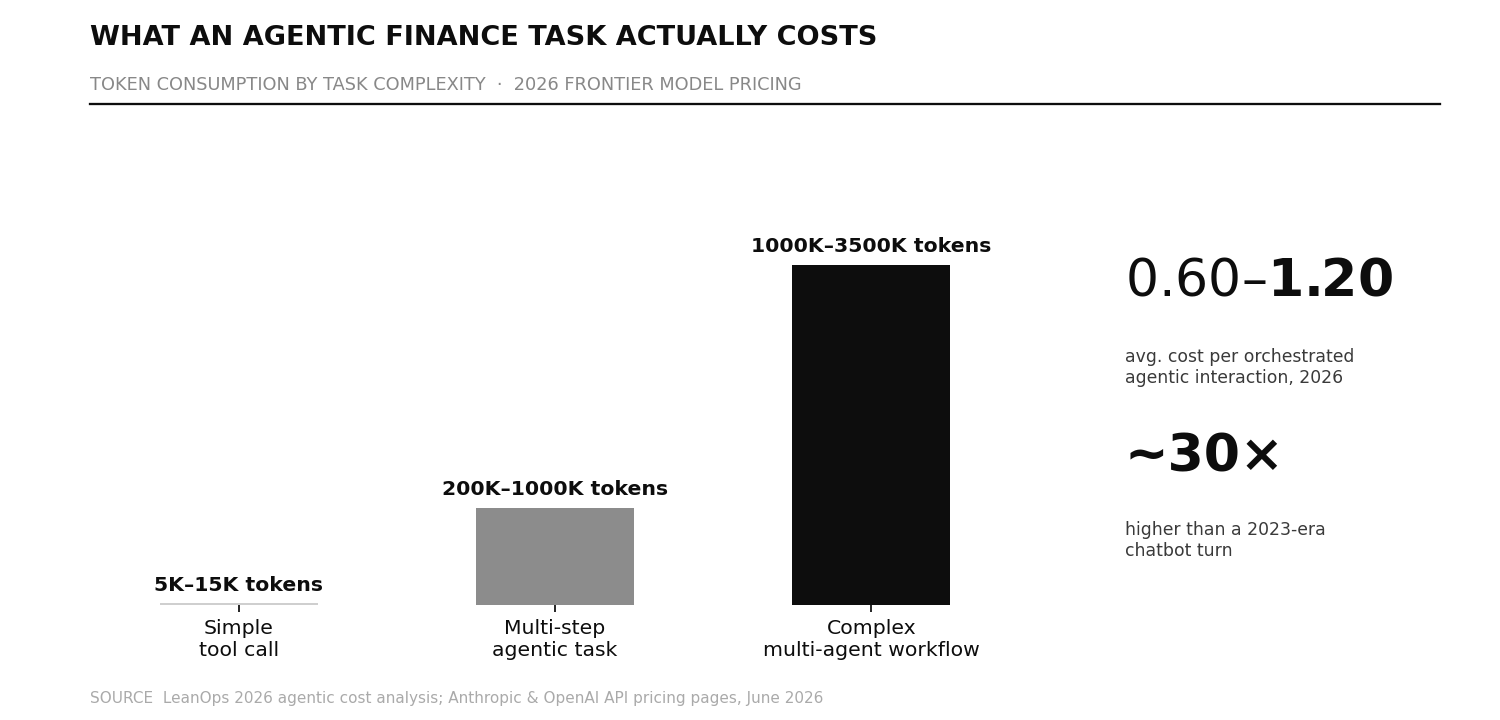
A simple tool call runs 5,000–15,000 tokens. A multi-step agentic task - an actual reconciliation, a drafted variance memo - runs 200,000–1,000,000. A complex multi-agent workflow with retries can blow past 3,000,000. At current pricing, a fully orchestrated agentic interaction costs roughly $0.60–$1.20 (about 30× a 2023-era chatbot turn). “Just plug it into an agent” stopped being a pricing strategy the day multi-step reasoning became the default. Tiered model routing - cheap models for lookups, frontier models only for the reasoning-heavy steps - is the difference between a blended cost of ~$2.31 per million tokens and $18.40 for teams that route everything to the frontier by default1.
The Build-vs-Buy Math
Two independent cost analyses — Azilen and DevCom — land on the same three build tiers without citing each other:
1️⃣ Entry-tier — $20,000–$30,000. A single-purpose agent (one workflow, minimal integration). 2️⃣ Mid-tier — $30,000–$60,000. A multi-step workflow wired into a handful of systems. 3️⃣ Complex, enterprise-grade — $60,000–$100,000+. Full governance, audit trail, multiple ERP/tax-engine integrations.
Finance adds a real premium on top of any tier, though the two sources frame it differently: Azilen calls it +50–100% over a general-purpose agent; DevCom puts finance and healthcare at a flat $70,000–$250,000+ once SOX and access controls are priced in. Different framing, same direction.
Budget $2,000–$20,000 a month in ongoing costs once it’s live. Payback is typically three to twelve months for a high-volume workflow — which lines up with BCG/Forrester’s 2026 data, putting median enterprise time-to-value at roughly 5.1 months.2.
The Effort/ROI Matrix: What to Build First
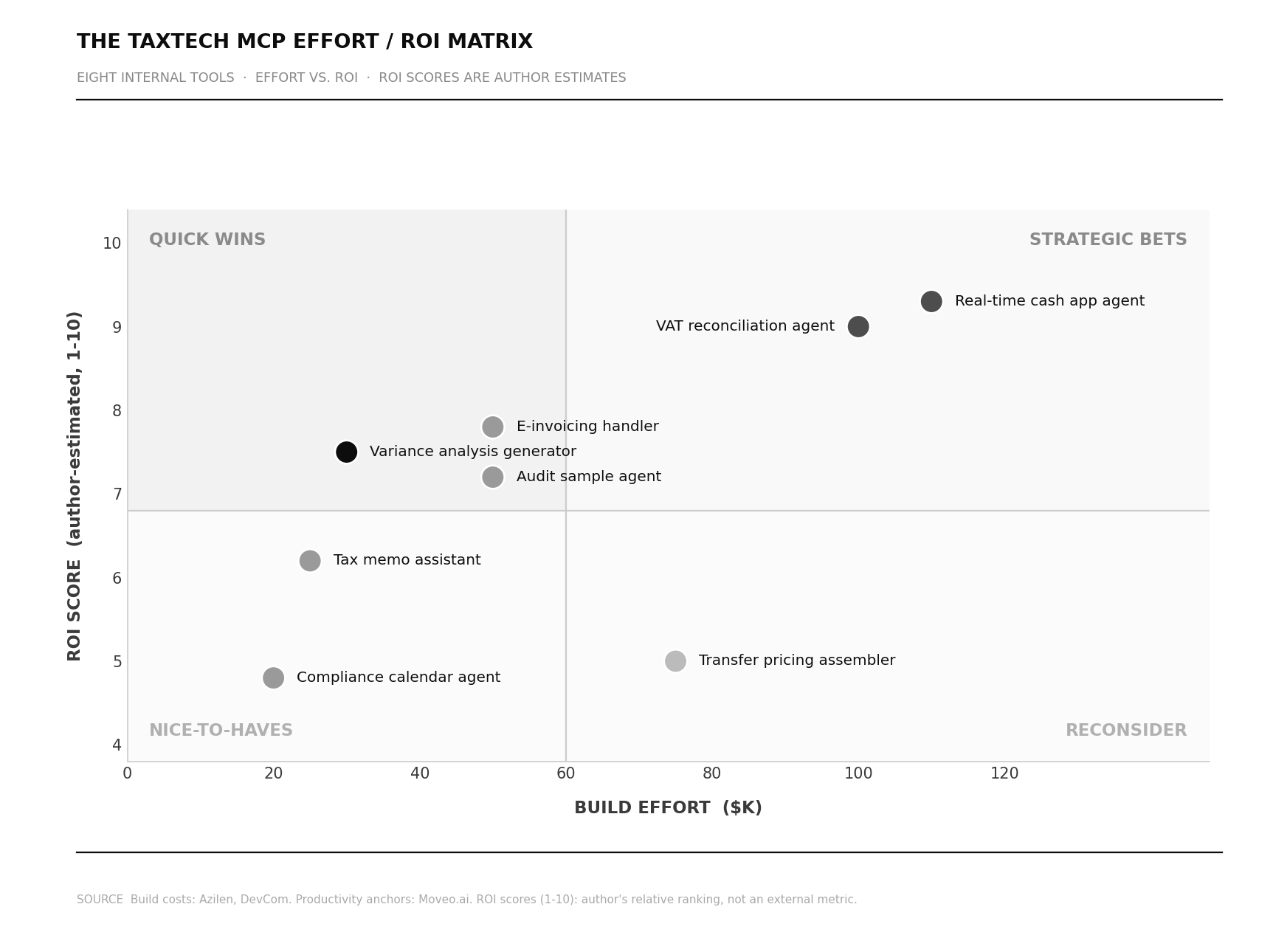
1️⃣ Best value — build this quarte. Variance analysis and close-commentary generation: ~$30,000 to build, ROI 7.5.
2️⃣ Biggest bets — expensive, but the math clears.
Real-time cash application / AP-AR matching: ~$110,000 to build, ROI 9.3. The 95% straight-through-processing benchmark is already live in production, not a vendor’s aspiration.
VAT reconciliation via MCP into your ERP and tax engine: ~$100,000 to build, ROI 9.0. This is the one eating directly into that 41%-of-your-team’s-time figure from earlier.
3️⃣ Worth doing, not urgent. A compliance calendar / filing-tracker agent: ~$20,000 to build, ROI 4.8. It won’t move a P&L line, but it buys your team peace of mind.
4️⃣ Reconsider before committing budget. A transfer pricing documentation assembler: ~$75,000 to build, ROI 5.0 — the weakest ratio of the eight. Jurisdiction requirements vary too much for a generalized agent to earn back its cost inside a normal planning cycle, unless your transfer pricing exposure is unusually concentrated.
As I laid out in The 2026 AI TaxTech Map, the indirect tax infrastructure layer — Avalara, Fonoa, Sovos, Thomson Reuters ONESOURCE, Vertex — is racing to ship this exact capability as a paid product, right now. Everything above assumes you’re weighing a build against those vendors. Not against doing nothing — that was never actually an option, you just haven’t priced it yet.
Curious to understand if anyone has tried building any of those. What type of Ai-supported apps work in an enterprise? Please share in the comments.


Frequently Asked Questions
What is the Model Context Protocol (MCP) and how does it work for enterprise? MCP is an open standard, originally built by Anthropic and now governed by the Linux Foundation, that lets AI agents connect to external tools, databases, and business systems through a single standardized interface instead of custom point-to-point integrations. In enterprise settings, an MCP server sits between the AI and the data source, enforcing governance policies before any action executes.
How much does it cost to build an AI agent for a finance team? Entry-tier: $20,000–$30,000. Mid-tier: $30,000–$60,000. Complex, audit-ready builds: $60,000–$100,000+. Finance agents carry a 50–100% premium over general-purpose ones due to compliance requirements. Typical payback: three to twelve months for high-volume workflows.
Is MCP secure enough for tax and financial data? It can be, but security isn’t automatic — enterprise-grade deployments need encrypted credential storage, read-only access by default, human-in-the-loop approval for exports, and audit logging. The risk isn’t the protocol; it’s connecting agents to production systems without IT review.
How much does agentic AI cost per task in token usage? Simple tool calls: 5,000–15,000 tokens. Multi-step workflows: 200,000–1,000,000. Complex multi-agent tasks: 3,000,000+. A fully orchestrated interaction costs roughly $0.60–$1.20 — about 30× a 2023-era chatbot turn.
What’s the ROI timeline for AI agents in finance and accounting? Most deployments recover build cost in three to twelve months when automating a genuinely high-volume workflow — reconciliation, cash application, tax prep — with a clear before/after metric. Lower-volume, highly variable workflows take longer to clear their cost, sometimes never do.
References & Further Reading
Anthropic — “Donating the Model Context Protocol and establishing the Agentic AI Foundation” — Accessed July 2026
AIToolsReview — “All 439 Claude Connectors: The Complete Directory (July 2026)” — Accessed July 2026
Perplexity Connectors awesome-list — “Finance and Investing” category — Accessed July 2026
Awesome MCP Servers — Finance, Productivity, Development, Database categories — Accessed July 2026
Google Cloud — “Announcing official MCP support for Google services” — Accessed July 2026
OpenAI Developers — “MCP – Apps SDK” — Accessed July 2026
Mistral AI — “Connect the dots: Build with built-in and custom MCPs in Studio” — Accessed July 2026
Composio — “DeepSeek MCP Integration for AI Agents” — Accessed July 2026
CFO.com — “Inside Claude’s rapid expansion across corporate finance” — Accessed July 2026
Moveo.ai — “Financial reconciliation in 2026: How AI agents are eliminating the manual bottleneck” — Accessed July 2026
Azilen — “How Much Does a Financial AI Agent Cost in 2026?” — Accessed July 2026
LeanOps — “AI Agents Burn 50x More Tokens Than Chats” — Accessed July 2026
Arcade.dev — “MCP Runtime Security for AI Agents in Accounting” — Accessed July 2026
How I got these numbers: token-consumption ranges per task complexity (5K–15K / 200K–1M / 1M–3.5M+) come from LeanOps' 2026 analysis of production agentic deployments. I converted those ranges to dollars using blended 2026 frontier pricing — Claude Sonnet 4.6 (~$3 input / $15 output per million tokens) as the representative mid-tier model, cross-checked against Claude Opus 4.8 ($5/$25) and GPT-5.5 ($5/$30) — which is how the $0.60–$1.20 per-interaction range and the ~30× multiplier over a 2023-era chatbot turn (roughly 500–1,500 tokens at 2023 pricing) were derived. The $2.31 vs. $18.40 blended-cost comparison reflects tiered model routing (cheap models for lookups, frontier models reserved for reasoning-heavy steps) versus routing every request to a frontier model by default. These are directional estimates, not a vendor-audited benchmark — actual cost will vary by architecture, retry rate, and how aggressively a team routes between models.
How I got these numbers: the build-cost tiers are corroborated across two independent vendor-cost analyses (Azilen, DevCom) that arrive at the same $20K/$30K/$60K/$100K breakpoints separately. The finance premium is directional, not a single agreed number — Azilen frames it as +50–100% over general-purpose agents, DevCom frames it as an absolute $70K–$250K+ range for regulated industries; both point the same direction even though the framing differs. The 5.1-month median time-to-value figure comes from BCG/Forrester data aggregated by an independent analyst, not from Azilen or DevCom, and lines up with the three-to-twelve-month payback window used elsewhere in this piece. None of this is a vendor-audited benchmark. Actual cost depends on team seniority, in-house vs. agency build, and how much compliance tooling already exists.
Hello Diyan. Thank you for publishing no BS TaxTech as there is a lot of BS out there.
Your effort/ROI matrix is the part worth sitting with longer than the connector counts. VAT reconciliation at 9.0 ROI, cash application at 9.3 — those numbers only clear if the underlying system was built to be called by an agent in the first place. Most of what's getting built right now is the opposite: a legacy tax engine with a chat UI stapled on, then months of integration work teaching an LLM to navigate a workflow designed for a human clicking through screens. That's where your $60K–$250K+ enterprise tier really comes from — the translation layer, not the tax logic.
That's the problem we started https://orchestrate.tax to solve. The orchestration layer is API-first and MCP-callable from day one — the same operations a controller triggers from a dashboard are what an agent calls directly, same audit trail, same governance, no translation layer in between. XMPT (exemption certificates) and TAXDAI (indirect tax intelligence) sit underneath as agent-callable services rather than siloed apps to reverse-engineer.
Practically, that collapses your build tiers rather than adding a fourth — a VAT reconciliation workflow becomes composing existing primitives instead of a $100K custom build.
One pushback: build-vs-buy still treats "buy" as one category. Buying a platform whose primitives were built for agents and buying a seat license for a platform now marketing itself as agentic aren't the same purchase, even if the sales deck reads the same. Worth a column in the next version of this map.
Interesting analysis. The emphasis on starting with high-volume workflows like reconciliation and cash application stands out. For finance teams, the real opportunity isn't simply adopting AI, but integrating it into governed processes where efficiency, accuracy, and measurable business outcomes can be demonstrated.