

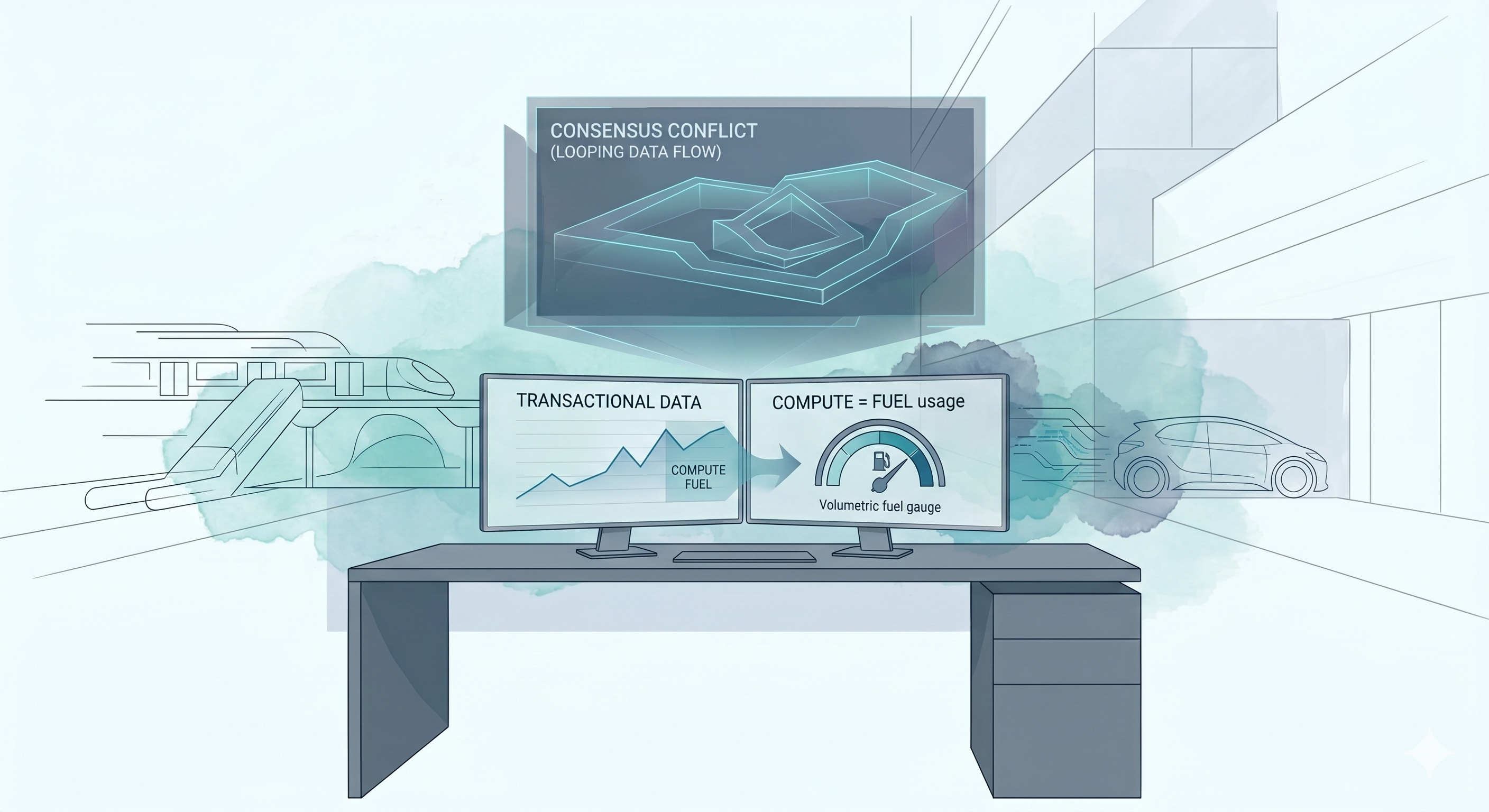
In the boardrooms of the S&P 500 and high-growth scale-ups, the “common wisdom” is that AI is primarily a productivity booster within specific workflows—a narrative fueled by marketing promises of an “era of builders” where everyone can create at scale. This is not wrong. But there is a twist. In 2026, we have transitioned from highly predictable, established SaaS pricing models to a “tokenized economy,” in which data is the input and output, and compute is the fuel, metered like a utility—a shift that makes real-time AI infrastructure stability as critical to the P&L as the tax logic being executed.
But here is the catch. You cannot manage a 2026 cost structure with a 2016 KPI dashboard. Here is the ground truth for the new KPI framework needed to navigate the tokenized economy today.
I. Latest Trends in AI Tech: The Tokenization of the S&P 500 Cost Structure
1. Enterprise Pricing: The Metered Reality
A look at the pricing models of the top 4 AI platform providers reveals that the era of the “flat-fee seat” is dead. We have entered the era of “utility AI”, in which compute is metered like electricity1:
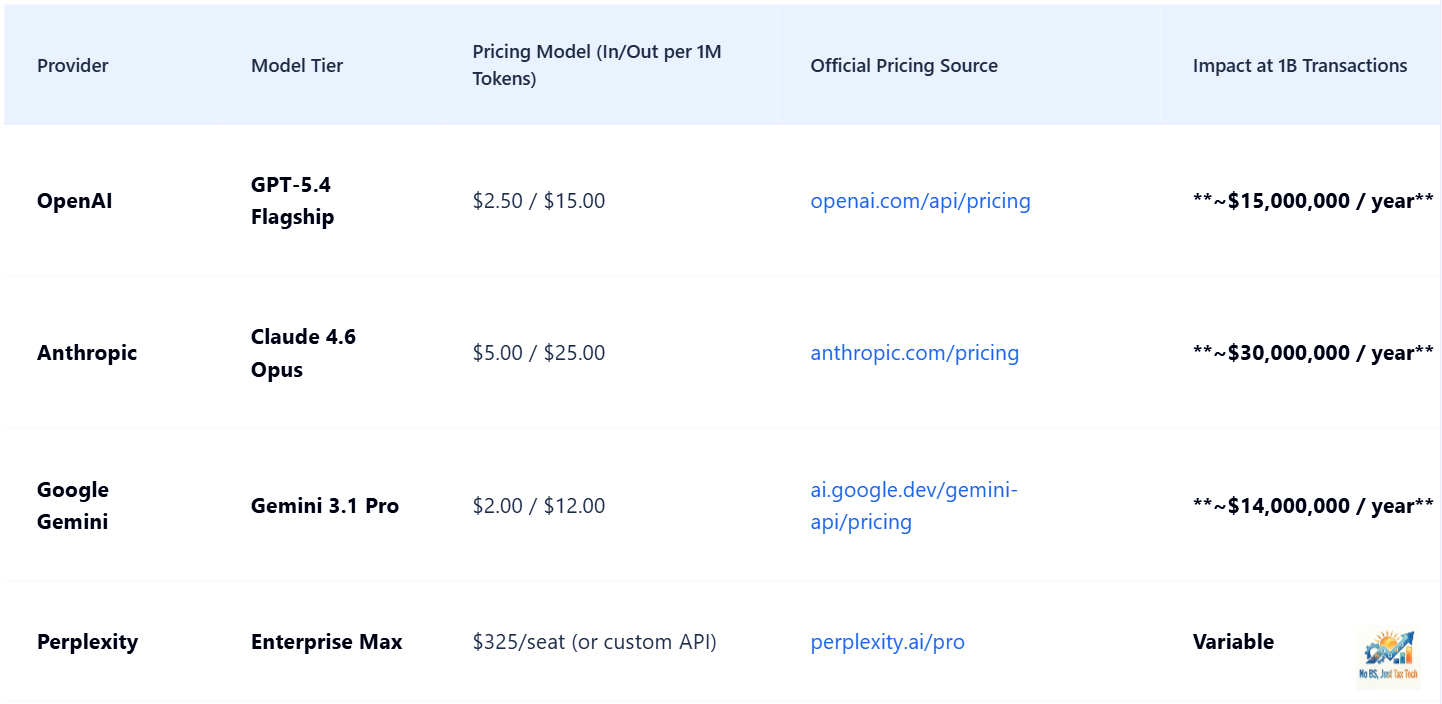
It’s clear that for the S&P 500—companies managing 100 million to more than 1 billion transactions per year—AI costs are a direct hit to the margins. This is also what Uber’s CTO, Praveen Neppalli Naga, recently confirmed. In this interview, he revealed that the company exhausted its entire 2026 Claude budget by April due to deep agentic integration. Uber's R&D expenses rose 9% to $3.4 billion in 2025, and the company expects that figure to keep climbing—suggesting AI may be as much a cost driver as a productivity lever.
2. The Stability Layer: Reliability Tracking
At the S&P 500 scale, downtime isn’t an inconvenience—it’s a breach of compliance. The gold standard is “four nines” (99.99%), which allows for only 52 minutes of downtime annually. Let’s look at how the AI platform providers are doing in 2026:
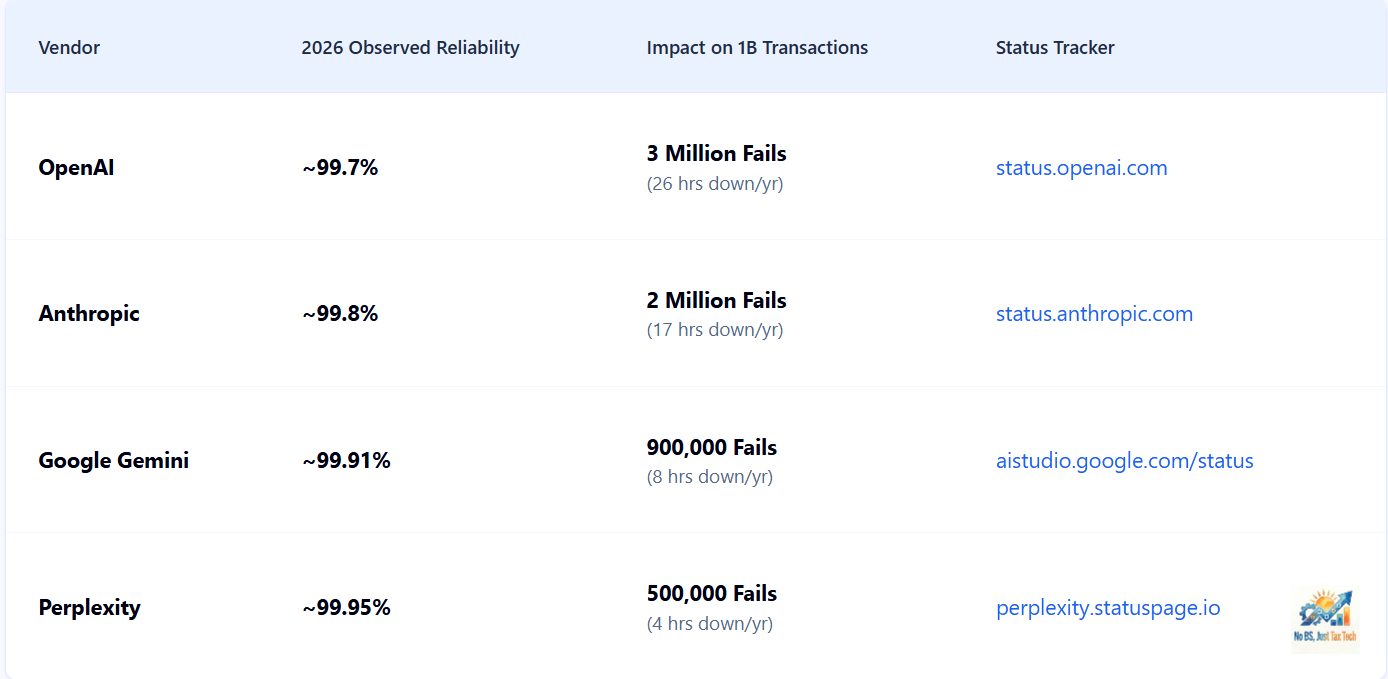
None of the major LLM providers currently guarantees 99.99% uptime during peak global cycles. So, any taxtech architecture must have a failover logic to hot-swap providers in milliseconds when a “brownout” occurs.
3. Ownership Disruptions: Related Parties and Consolidation
In 2026, the AI world is one of related parties and imminent consolidation. Here are only the recent signals:
The SpaceX-Cursor Vertical Integration: SpaceX has secured a $60 billion option to acquire Cursor to fill xAI’s infrastructure gap.
This signals that the infrastructure used to build AI is as valuable as, if not more valuable than, the models themselves. If your infrastructure is tied to a platform that gets acquired, the impact may not be convenient.
The OpenAI-Microsoft “Risk Factor”: In recent draft IPO filings, Sam Altman officially labeled Microsoft a “risk factor” due to OpenAI’s deep dependence on their compute.
When such partnerships signal strategic friction, you must prepare for a change in compute infrastructure that could spike your costs overnight.
The Anthropic-Amazon “compute debt”: Anthropic and Amazon have committed $100 billion to AWS custom Trainium chips.
This creates a new vendor lock-in. If you are integrated with Claude, you are now effectively an AWS-dependent entity, regardless of your primary cloud strategy.
In summary, the shifting landscape introduces risks such as:
Pricing drift
The variance between forecasted and actual compute costs is often driven by vendor-side pricing changes or inefficient “infinite loops” in agentic workflows that consume tokens without generating value.
Infrastructure fragility
The systemic risk of service outages or data bottlenecks stems from an AI provider’s inability to scale compute resources to match your global transaction volume.
Model latency
The time-lag between a data input and an AI output. At scale, high latency isn’t just a slow app; it can be a blocked checkout or a failure in real-time compliance reporting.
In other words, if your tax data is latent or your vendor stack is fragile, your AI becomes an expensive way to generate errors at the speed of light—transforming a potential efficiency engine into a high-frequency audit liability.
So, what’s the right course of action to mitigate those risks?
To mitigate these risks, the traditional fintech/taxtech KPI dashboard is no longer sufficient. We are moving toward dynamic, metered infrastructure with significant cost implications — a shift that requires a new set of KPIs to protect the bottom line. Here is how I would stay ahead:
No Infinite Spending Loops: Agentic AI can enter recursive loops that burn $100,000 in tokens before you finish your morning coffee. You need hard “circuit breakers” at the API level to stop runaway costs.
Get a Grasp of ROI: Stop using AI to only write memos or summarize meeting notes. Use it to automate the 4,000 manual monthly reconciliations that keep your accounting team up at night. The highest returns are found in escaping the manual loop, not executive dashboards or piles of memos.
Own Your Logic Library: If you bake your proprietary tax logic into a specific vendor’s prompt, as Xero did, you are a hostage to their uptime and pricing. Build for model agnosticism so you can migrate from OpenAI to Gemini in under 24 hours.
Audit for Infrastructure, Not Just Model Performance: With SpaceX securing a $60 billion option to acquire Cursor, the infrastructure that builds the code is now as valuable as the AI itself. Ensure your vendors are built on hyperscale foundations (Google/AWS/Azure) that can actually handle your transaction volume.
II. The S&P 500 TaxTech Dashboard
For the Chief Tax Officer or VP of Engineering, the greatest risk in 2026 isn’t a single audit; it’s invisible inefficiency. At the S&P 500 scale, you cannot manage what you do not measure. Therefore, we need KPIs that move beyond “monitoring” to “ROI orchestration,” i.e., actively managing the unit economics of compliance. Your dashboard should be more than a status report—it should be a decision engine that incorporates AI efficiency.
Here's my proposal for a scalable TaxTech Dashboard at the S&P 500 level:
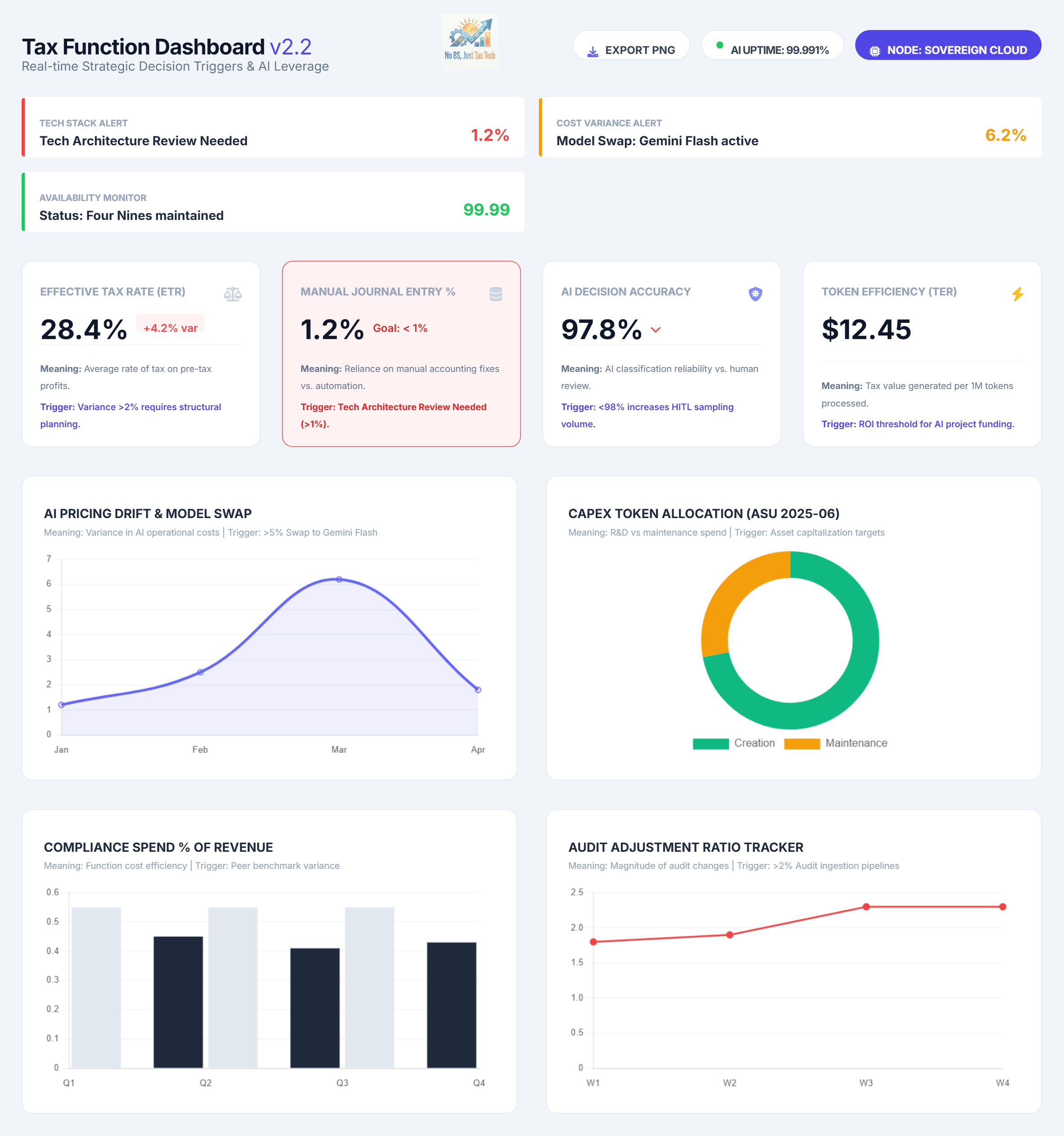
Along with the traditional metrics such as Effective Tax Rate, Compliance Spend, and % of Manual Journal Entries, TaxTech leadership must follow some new KPIs:
1. AI Pricing Drift (Delta %)
With the end of the “flat-fee era,” the AI costs are now as volatile as energy prices. This KPI tracks the per-token spend variance. For example, if weekly drift exceeds 5%, the dashboard triggers an automated “model swap,” routing low-complexity tasks to more cost-effective tiers.
2. AI Decision Accuracy (%)
In 2026, manual troubleshooting is the silent killer of scale. This KPI tracks the percentage of tax triages handled by AI without human intervention. If it dips below 98%, for example, the dashboard should automatically increase the “human-in-the-loop” sampling rate to prevent systemic audit risks.
3. Token Effectiveness Ratio (TER / 1M tokens)
This KPI identifies exactly how many tokens are converted into defensible compliance outcomes versus the compute waste generated by recursive loops like API validation ping-pong (endless retries against failing portals), consensus conflict (agents arguing over logic until quotas are exhausted), or hallucination spirals (expensive internal reasoning used to resolve contradictory data). By tracking TER, budget owners can detect these “inference leaks” before they decimate quarterly results, ensuring the system maintains a defensible 1:1 ratio rather than slipping into the 1:1000 efficiency abyss that defines unmanaged infrastructure.
4. AI Latency & Uptime
In the fintech world, 5 seconds is an eternity. This metric tracks the milliseconds between a transaction and its tax-defensible status. Any dip below 99.99% reliability triggers a failover to a secondary sovereign cloud instance.
5. CAPEX Token Allocation
In the tokenized economy of 2026, CAPEX Token Allocation (ASU 2025-06) is extremely important. Following the 2025 FASB update regarding AI software capitalization, organizations must now surgically differentiate between tokens consumed for “creation”—the R&D and asset-building phases that qualify as capitalizable investments—and those used for “maintenance”, which hit the books as immediate operational spend. By monitoring this metric through real-time financial telemetry, budget owners can meet specific asset capitalization targets, thereby demonstrating to auditors that their AI spend is building a long-term intangible asset rather than merely subsidizing an expensive, ongoing maintenance loop.


Strategic Forecast
Over the next 24 months, the most successful FinTax leaders will shed their traditional “Head of Tax” skins and re-emerge as VPs of Compliance Infrastructure. In this new reality, the silo between the tax department and the platform engineering team will vanish entirely, replaced by a shared mandate: the real-time management of compliance telemetry. The standard for success will shift from “getting it done” to algorithmic efficiency. Expect to see:
The Rise of the TER Audit: The Token Effectiveness Ratio (TER) will shift from a niche DevOps metric to a primary audited financial disclosure. The market will begin to value AI-enabled firms by their compute-to-compliance efficiency, with a ratio approaching $TER = 1:1$ (one successful outcome per unit of spent compute) representing a competitive moat, while anything higher signals an unmanaged inference leak.
Drift-Triggered Rerouting: Pricing drift will become the new “interest rate risk.” Companies will deploy automated arbitrage bots that “hot-swap” compliance logic across LLMs (OpenAI, Anthropic, or Gemini) in milliseconds, based on real-time price-per-token volatility and latency performance.
The End of the Monthly Close: As AI decision accuracy stabilizes above 99%, the concept of a monthly close will become a legacy term. We are moving toward “continuous compliance”, where tax filings are an automated, real-time byproduct of a data stream, and audit readiness is a constant state rather than a quarterly fire drill.
If you aren’t metering your way to ROI today, you aren’t just falling behind—you are accruing massive technical and fiscal debt that no amount of human “productivity” will be able to pay off.
FAQs: The 2026 Tokenized Economy
What is the “Tokenized Economy” in 2026?
The tokenized economy represents a shift from flat-fee SaaS pricing to a metered “utility AI” model. In this framework, data acts as the input/output, while compute is treated like electricity—metered and billed based on consumption. This makes real-time infrastructure stability a critical factor in a company’s P&L.
Why is the “flat-fee seat” model dying for enterprise AI?
As companies like Uber integrate deep agentic workflows, the volume of transactions (often exceeding 1 billion annually) makes per-user pricing unsustainable for providers. Utility AI allows providers to bill for the actual compute consumed, ensuring margins are protected as agentic complexity scales.
What is the Token Effectiveness Ratio (TER)?
The Token Effectiveness Ratio (TER) is a KPI that measures the ratio of AI tokens converted into defensible outcomes to the amount of waste. A 1:1 ratio is the gold standard, while higher ratios indicate “inference leaks” caused by recursive loops, hallucinations, or redundant API validation.
How does ASU 2025-06 affect AI spending?
Under the ASU 2025-06 FASB update, organizations must surgically differentiate between tokens used for “creation” (capitalizable R&D) and “maintenance” (operational spend). CAPEX Token Allocation allows companies to build long-term intangible assets on their balance sheets rather than just incurring ongoing expenses.
What are the main risks of AI infrastructure fragility?
The primary risks include pricing drift (volatility in token costs), infrastructure fragility (service outages during peak periods), and model latency. In 2026, a 5-second delay in AI processing can lead to blocked checkouts or failures in real-time tax compliance reporting.
How can companies achieve “model agnosticism”?
To avoid vendor lock-in and mitigate downtime, firms must build a proprietary logic library independent of any single LLM. This allows them to “hot-swap” between providers such as OpenAI, Gemini, or Anthropic in under 24 hours, based on real-time pricing and performance telemetry.
What is “Continuous Compliance”?
Continuous compliance is the 2026 standard, where tax filings are a real-time byproduct of automated data streams rather than a monthly manual “close.” As AI decision accuracy stabilizes above 98%, audit readiness becomes a constant state, eliminating the need for traditional quarterly fire drills.
References & Sources
Anthropic Pricing: Anthropic Shifts Enterprise Billing to Per-Token Pricing (Implicator.ai, April 14, 2026).
Uber AI Budget: Uber CTO Shows Claude Code Can Blow AI Budgets (The Information, April 10, 2026).
SpaceX-Cursor M&A: SpaceX Secures Right to Acquire Cursor for USD 60 Billion (LatestLy, March 28, 2026).
OpenAI: Official API Pricing Guide (Accessed April 22, 2026).
Google Gemini: Vertex AI Pricing Overview (Accessed April 22, 2026).
Vertex Resource Library: AI and Indirect Tax Trends (Accessed April 22, 2026).
PwC Tax Tech: Unlocking Value in Tax Technology (Accessed April 22, 2026).
Platform M&A & Infrastructure: Musk’s SpaceX bets $60 billion on Cursor to fix xAI’s coding gap (The Decoder, April 2026).
Accounting Standards (ASU 2025-06): Accounting Best Practices for AI Use in Software Development (Broadcom/Clarity, April 2026).
Unit Economics & Pricing: Anthropic Shifts Enterprise Billing to Per-Token Pricing (Implicator.ai, April 14, 2026).
Performance & ROI: Want ROI from AI? Go for growth (PwC Global, April 2026).
System Reliability Benchmarks: Real-Time Availability & Status Monitor (OpenAI, April 2026) and Anthropic System Status (Anthropic, April 2026).
Sovereign AI & Compliance Risk: The Sovereign AI Boom and Trillion-Dollar Predictions (Motley Fool, April 2026) and Legal Analysis of AI Compliance Risks (Northman & Sterling, March 2026).
📊 The Math Behind the Bill:
What is a “Transaction”? In this context, a transaction is a compliance event —a single lifecycle moment (payment, refund, or tax validation) that requires the AI to process the transaction data against current tax laws.
The Calculation: We assume an average context window of 1,000 tokens per transaction (covering the system prompt, the raw transaction data, and the structured tax output).
Formula: (1 Billion Transactions × 1,000 Tokens) / 1,000,000 × Price per 1M Tokens = Annual Cost.