

Weekly insights for Tax & Product Leaders. No slop, just interesting data points you can reflect on with your ☕ :)
🎯 Start with the outcome. Not the data.
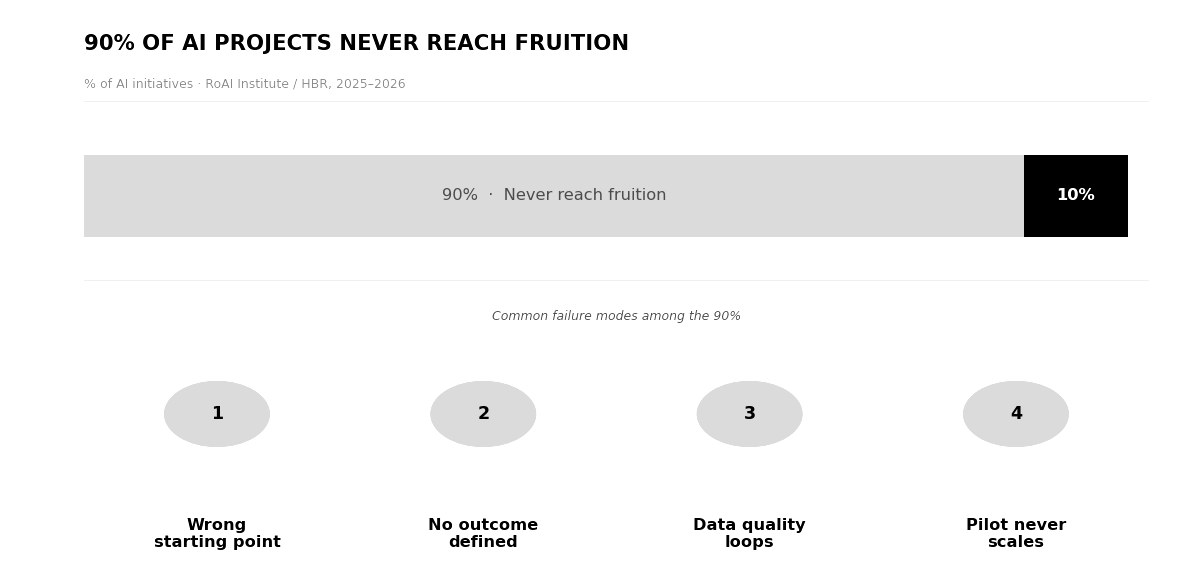
90% of AI projects never reach fruition. Not because of bad data, but because of the wrong starting point.
According to the research, most TaxTech projects begin with a data inventory - invoices, spreadsheets, PDFs, and returns.
The 10% that work start with “we need to close VAT reconciliation in 48 hours.” A defined outcome. Everything else follows from that.
RoAI Institute, “Crossing the AI Chasm: Start with Outcomes, Not Data” · HBR, “Most AI Initiatives Fail. This 5-Part Framework Can Help,” November 2025
🪤 Pilot purgatory. Where most AI initiatives die.
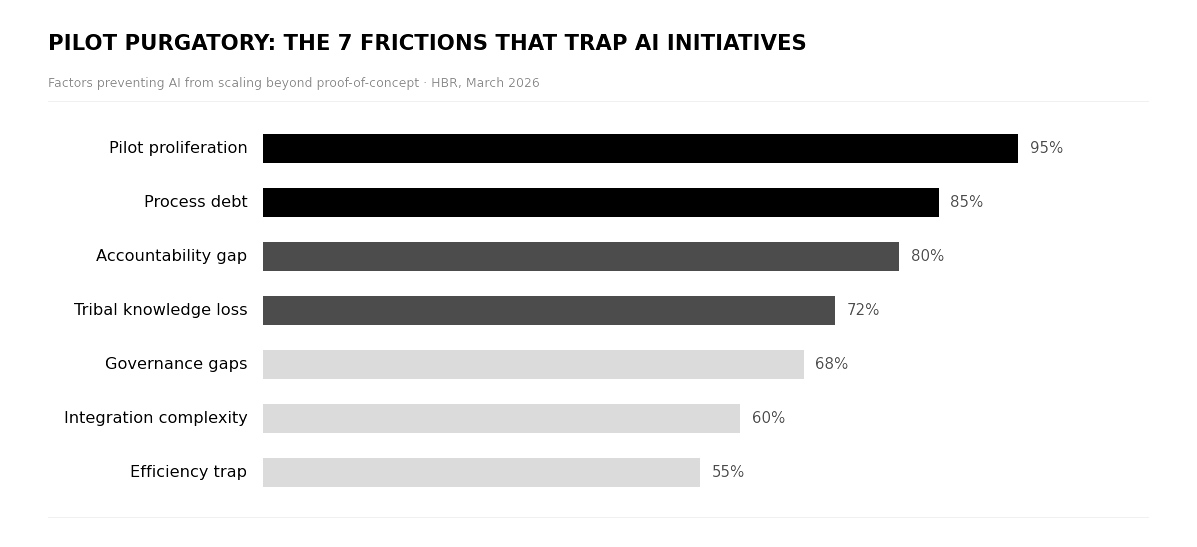
HBR calls it “pilot purgatory”: an AI initiative succeeds in proof of concept, then stalls before it scales. They mapped 7 frictions behind it — pilot proliferation, process debt, accountability gaps, tribal knowledge loss, governance failures, integration complexity, and the efficiency trap.
Look at that list from a tax function’s perspective, and you’ll recognize every single one.
Clean-sheet process redesign is the only exit. That requires a product manager, not a project manager, as I argue elsewhere.
HBR, “The Last Mile Problem Slowing AI Transformation,” March 2026
💰 By 2029, strategic CFOs will add 10 margin pp.
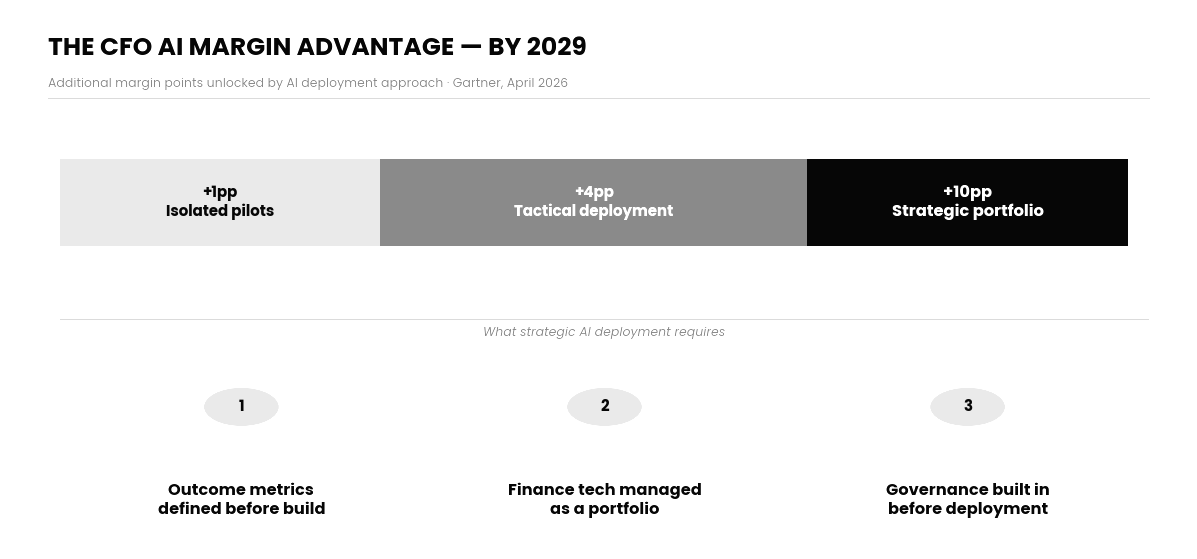
Gartner, April 2026: CFOs will add tremendous value (i.e. improve the P&L) not from AI pilots but from managing AI tech as a portfolio with outcome metrics built in from day one.
Tax is a margin lever. Every recovered VAT euro, every avoided penalty is direct P&L. CFOs designing TaxTech against financial outcomes now are building that advantage — compliance first, features second. Everyone else is watching demos.
📉 74% want AI to grow revenue. 20% are doing it.
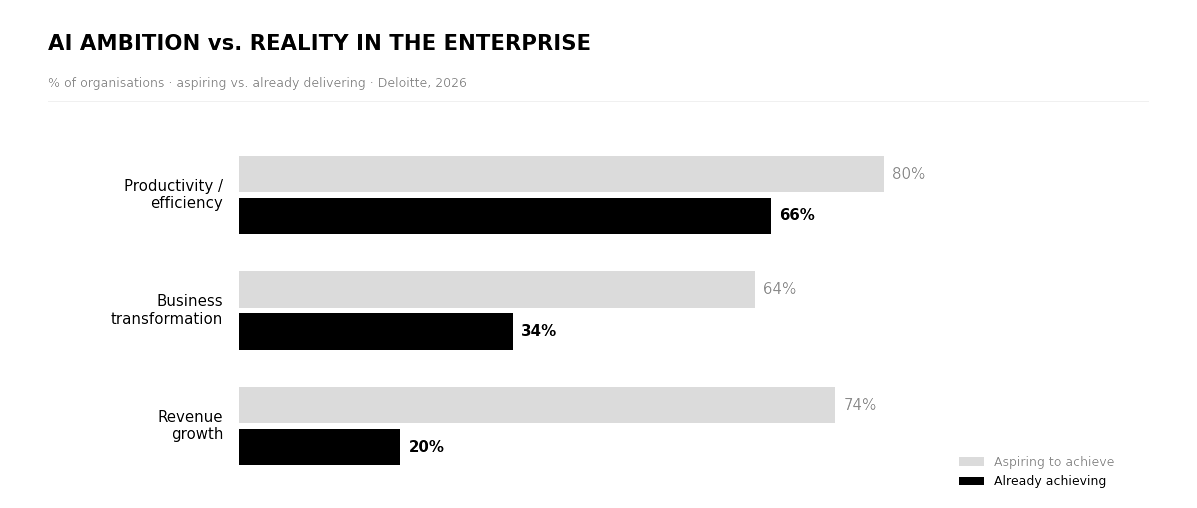
Deloitte, 3,200+ leaders: Only 20% of the interviewed actually achive revenue growth when using AI. That’s not a technology gap — I would aruge that it’s a design choice made from the beginning. Revenue impact requires defining the outcome before you build and holding someone accountable for the result. Most organizations skip both.
Deloitte, “State of AI in the Enterprise 2026,” surveyed 3,200+ leaders, Aug–Sep 2025
🔍 72% of CIOs are losing money on AI. Here’s what separates the 28%.
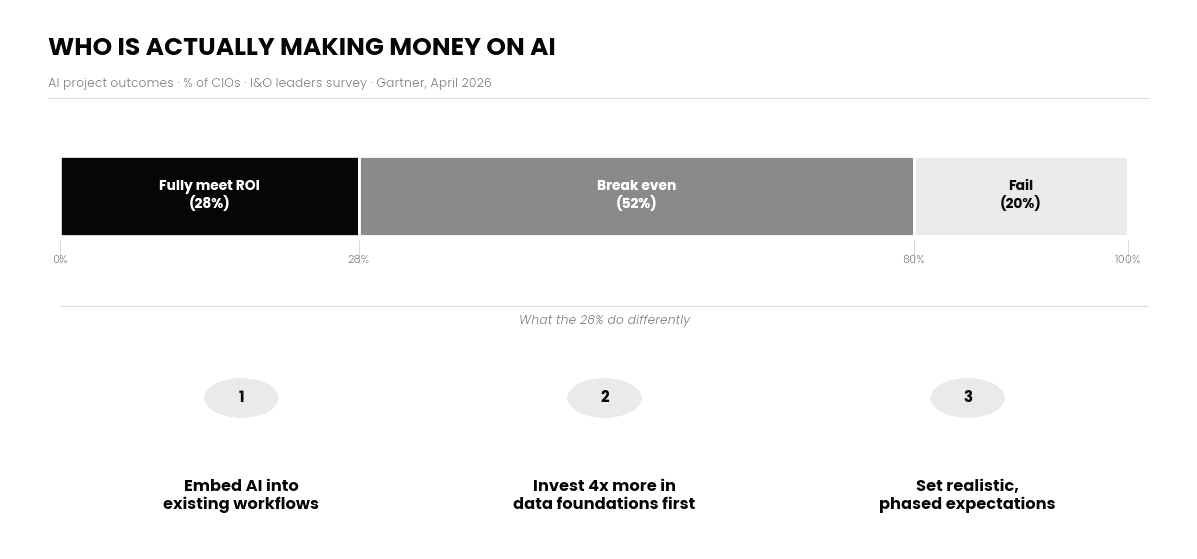
Gartner, 782 I&O leaders: 72% of CIOs are breaking even or losing money on AI. The 28% who succeed embed AI into existing workflows and invest 4× as much in data foundations before any model is deployed.
For tax: the hard decision isn’t which tool to buy — it’s whether to invest in the integration layer before the business case is approved. You can’t model your way out of a data architecture problem.
Gartner, “AI Projects in I&O Stall Ahead of Meaningful ROI Returns,” April 7, 2026 · Gartner, “Organizations with Successful AI Initiatives Invest Up to Four Times More in Data and Analytics Foundations,” April 16, 2026
Missed Issue #001? Read more about the data readiness gap in enterprise AI.


