

Tax enforcement went agentic. Your tax compliance didn’t.
That sentence likely lands somewhere between “interesting” and “uncomfortable” for many TaxTech leaders. The assumption that has governed enterprise tax strategy for the last decade — buy/build a compliance tool, let the tax team run it, move on — has quietly broken.
And the people who need to fix it must start asking the right questions.
The New Watchdog Doesn’t Read Returns
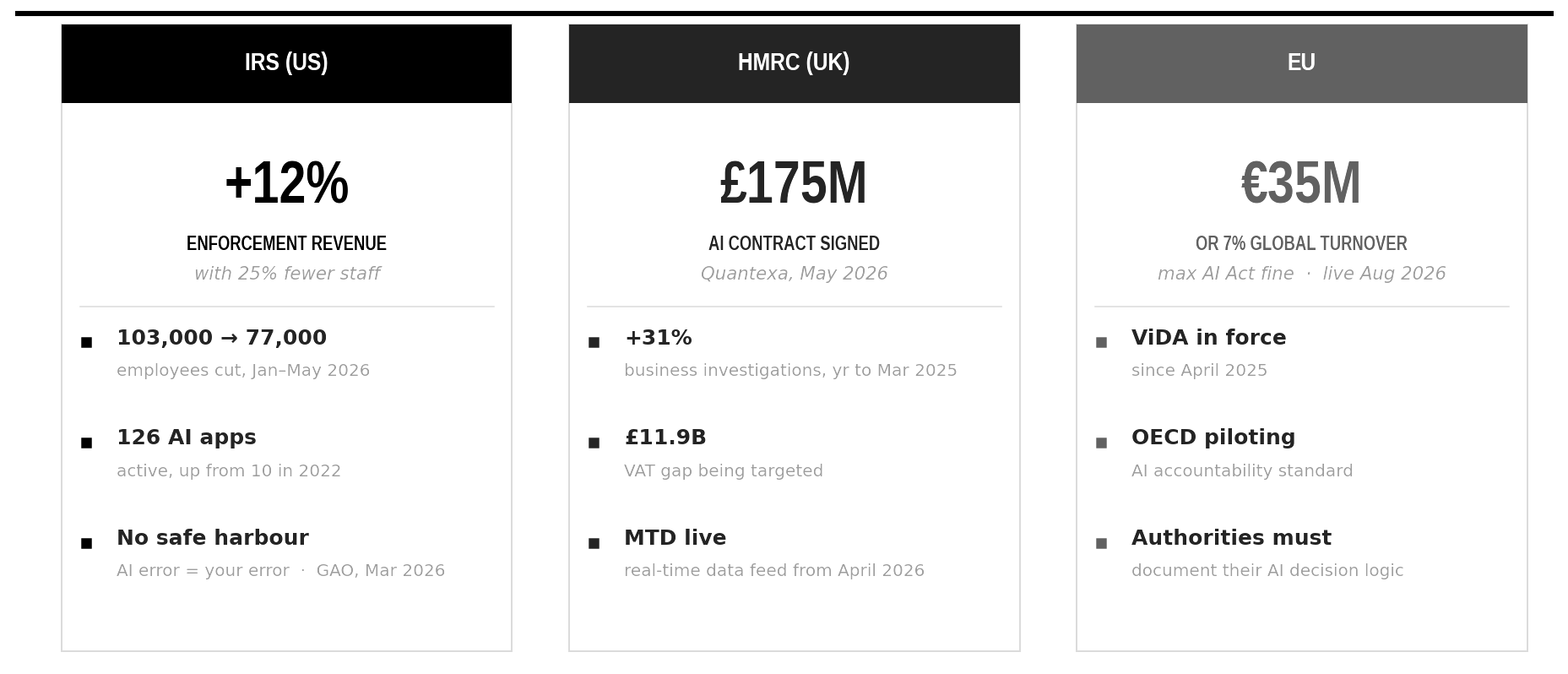
The IRS now runs 126 active AI applications targeting audit selection, fraud detection, and pattern matching — up from 10 in 2022. HMRC just awarded a £175M, ten-year contract to Quantexa — a platform originally built for financial crime detection at banks — to cross-reference every UK business entity against a unified data infrastructure it’s building from scratch. The EU AI Act’s full high-risk AI enforcement lands on 2 August 2026 — fines for prohibited AI practices are already active at up to €35M or 7% of global turnover; high-risk non-compliance from August carries a further exposure of up to €15M or 3%.
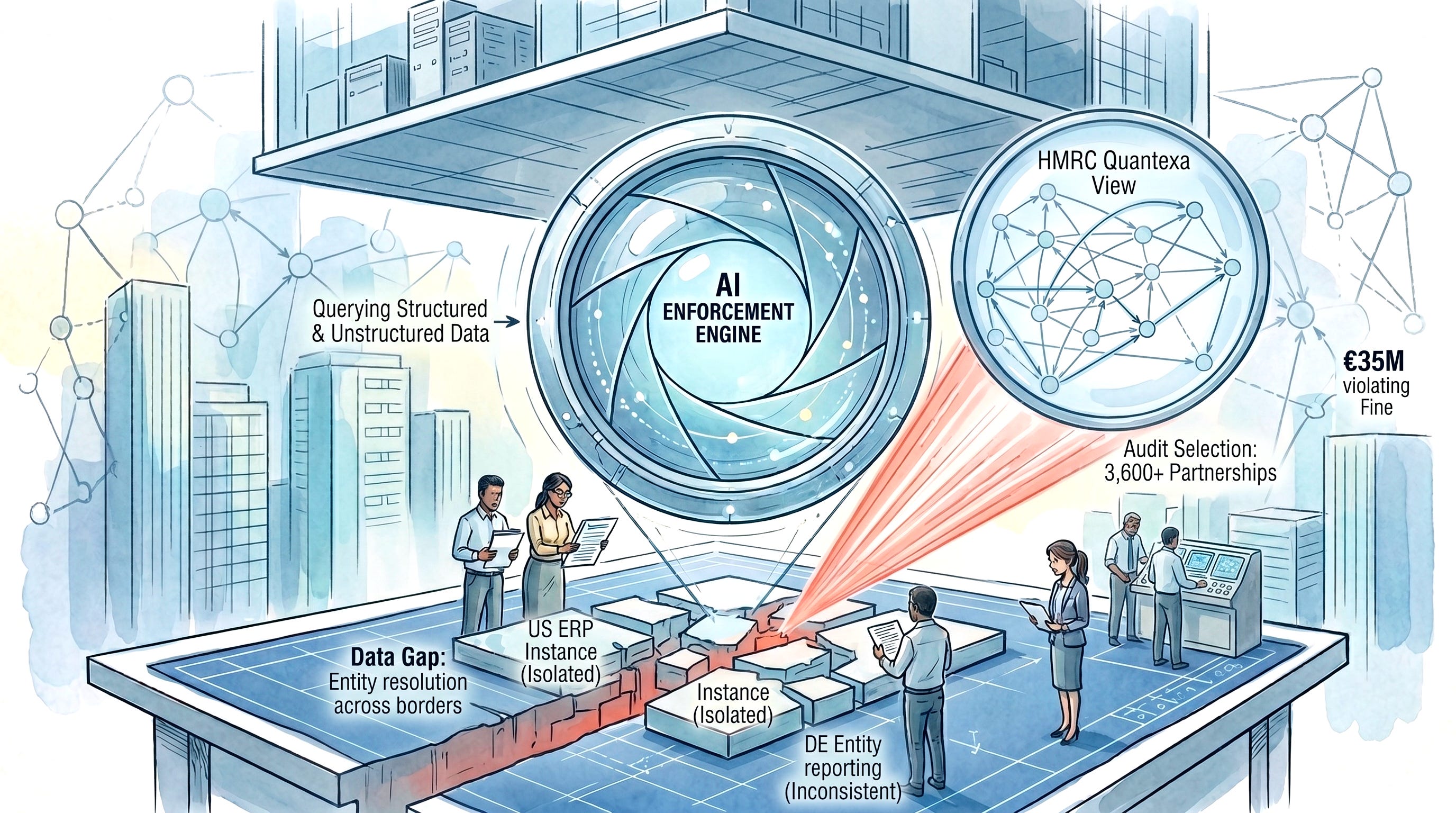
These systems don’t review returns the way a revenue agent does. They query structured (and probably unstructured) data. They resolve entities across fragmented datasets. They build graph models of your corporate structure, intercompany flows, and VAT reclaim ratios — and compare them against sector benchmarks, peer groups, and expected configurations at scale. The IRS AI has already selected 3,600+ large partnerships for examination. It didn’t do that by only reading PDFs.
The critical distinction is that these systems are looking at your data, not your return.
The return is the structured output of your data pipeline. If the pipeline is fragmented, entity resolution is inconsistent across jurisdictions, or your intercompany flows don’t reconcile cleanly, the algorithm finds the gap. This is when you also start blipping on the tax authority’s radar.
What HMRC Just Revealed About Your Stack
The Quantexa contract is worth studying in detail because what HMRC is building on the enforcement side mirrors what most enterprise tax teams haven’t built on the compliance side.
Quantexa’s platform was built for entity resolution at scale — connecting fragmented data from multiple sources, resolving identities across datasets, and using graph analytics to surface patterns that no human team could find manually. HMRC’s stated goal is a single, trusted, connected view of every taxable entity in the UK, built from data currently stored across multiple legacy systems that don’t communicate with each other.
Read that again from the other side of the table: HMRC is solving the data fragmentation problem on the enforcement side. Most enterprise tax teams haven’t solved it on the compliance side. The authority will soon have a cleaner, more connected view of your entity structure than your ERP does.
The gap between those two data states is your risk exposure. Closing it is an engineering project.
Three Questions to Run Internally This Quarter
Can you reconstruct the lineage of any tax position in your stack?
Not the final number — the lineage. Which transaction triggered it, which rule applied, which data source it came from, and which engineer last touched the pipeline that produced it? If the answer takes more than a day to produce, your lineage is not audit-defensible against an algorithmic adversary.Is your entity model consistent across jurisdictions?
If the same legal entity appears differently in your US ERP instance, your UK instance, and your EU reporting layer, an AI enforcement system will notice. A human auditor might accept an explanation. The algorithm flags the inconsistency and moves on. Run the cross-jurisdiction entity reconciliation before Quantexa does.What is the data freshness SLA for your compliance outputs?
HMRC’s Making Tax Digital has been feeding continuous transaction data into Quantexa’s platform since April 2026. If your compliance tool produces a quarterly filing from data that’s already 90 days stale, and the enforcement system queries real-time transaction patterns against that filing, the mismatch is your exposure, not your return.
When an AI enforcement inquiry arrives — and it will arrive not as a letter but as a model’s conclusions, already formed before the inquiry is even sent — the tax team will need to answer data questions that you can only address if you have planned for it. This gap is where enterprise exposure lies in 2026.
The adversary is now a data system. The only defensible response to a data system is better data.



References & Further Reading
U.S. GAO — “Artificial Intelligence: IRS Actions Needed to Address Skills Gaps, Information Quality, and Strategic Management” — https://www.gao.gov/products/gao-26-107522 — Accessed May 2026
The Next Web — “HMRC awards £175 million AI contract to British firm Quantexa to close £46.8 billion tax gap” — https://thenextweb.com/news/quantexa-hmrc-ai-tax-fraud-sovereignty — Accessed May 2026
FinTech Futures — “Quantexa lands £175m HMRC contract for data infrastructure overhaul” — https://www.fintechfutures.com/partnerships/quantexa-lands-175m-hmrc-contract-for-data-infrastructure-overhaul — Accessed May 2026
Capitol Technology University — “Audited by an Algorithm: How the IRS Is Using AI in 2026” — https://www.captechu.edu/blog/audited-algorithm-how-irs-using-ai-2026 — Accessed May 2026
U.S. GAO — “Inside the IRS’s Use of Artificial Intelligence” — https://www.gao.gov/blog/inside-irs-use-artificial-intelligence — Accessed May 2026
Thomson Reuters — “Tax firm AI platform vs. point solution: 2026 buyer’s guide” — https://tax.thomsonreuters.com/blog/tax-firm-ai-platform-vs-point-solution-2026-buyers-guide/ — Accessed May 2026
PwC — “Navigating the shift to an AI-powered tax operating model” — https://www.pwc.com/us/en/services/tax/library/tax-operating-model-ai-shift.html — Accessed May 2026
Axis Intelligence — “EU AI Act News 2026: Compliance Requirements & Deadlines” — https://axis-intelligence.com/eu-ai-act-news-2026/ — Accessed May 2026