

Last week, Paul Guyer, creator of the Nexus Tax News, and I discussed all things taxtech, AI, career choices, and more. I put a short teaser and a link to the full discussion at the end of this article. Over the next eight weeks, I’m writing up some deep dives into different aspects of the discussion - the roles of the TaxTech Manager and the Tax Product Manager (this one), the taxtech stack, taxtech SaaS solutions pricing predictions, the taxtech career in the age of AI, and some others.
Paul’s first question was: Is “product manager” just a tech-company label for a tax technology manager?
No. And I used to argue that with survey data. Then I decided that if I’m going to claim two roles are fundamentally different, I should read what companies actually write when they’re hiring for each one. So I scanned 21 real job postings this month: 11 for TaxTech Manager-type titles and 10 for Product Manager-type titles. Small sample, but coming from the real world.
Criteria 1: what each role is allowed to say no to
The easiest way to assess authority and similarity in this case is to outline what each role can veto unequivocally. I searched for the word “own” across all 21 postings to identify an aspect the role can approve/reject. Also, companies write job ads more honestly than they write org charts, because nobody proofreads a job ad for politics.
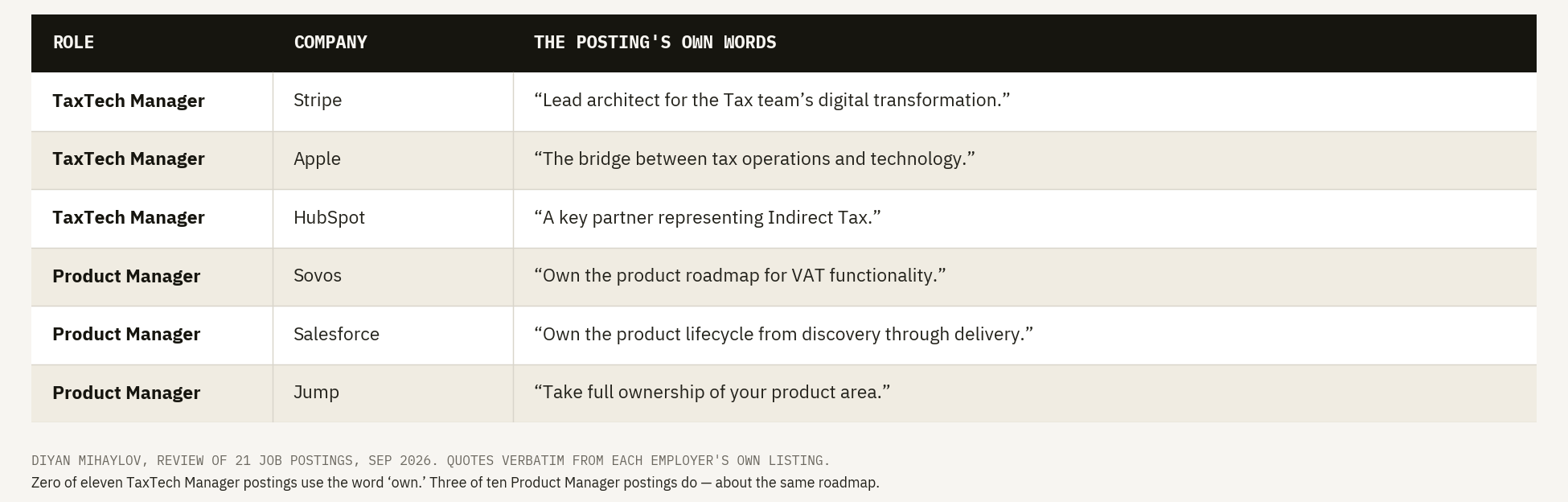
None of the TaxTech Manager ads mentioned ownership. They use “lead,” “partner,” “bridge,” “support,” “drive.” Three of ten Product Manager ads explicitly use “own,” about the same thing every time: the roadmap.
To sum up, a tax technology role can say no to a tool, process, or a new SaaS at best. However, the TaxTech Manager does not own product launches, OKRs, or top- or bottom-line impact through the roadmap.
This is the remit of the product manager, who can say no to a product launch and be fully responsible for the financial consequences. Everything else follows. For example, as a PM, I often evaluate and decide how to incorporate tax requirements, such as e-invoicing, VAT reporting, and invoice issuance, into broader product flows (e.g., the Uber app’s checkout flow).
Criteria 2: who sits where in the transaction stream
In short, not the tax department. In reality, somebody decides how a product/service is priced, which customers to target, what GTM strategy to use, what promos/discounts to offer, and what a service is called in the product taxonomy. I’ve sat in plenty of those meetings. Taxation and tax considerations are but an afterthought of all of this that sits downstream. And everything downstream is a reconstruction of a decision made by someone who wasn’t thinking about VAT or e-invoicing.
So this is also a critical difference: the TaxTech Manager’s role starts downstream, while the product manager has to have a holistic view, know why we are all here, and understand how the entire customer experience flows.
Criteria 3: experience and skills
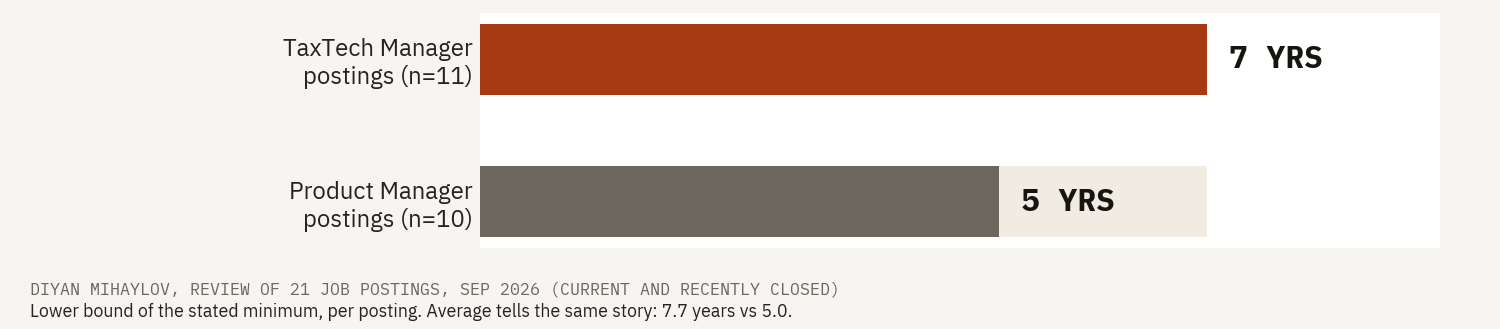
Eleven TaxTech Manager postings asked for a median of 7 years of experience before they’d talk to you. Ten Product Manager postings asked for five. Two years doesn’t sound like much until you notice what it buys: the tax technology seat is gate-kept by tenure in tax, the product seat by tenure in product.
At first glance, the tax technology seat asks for 40% more tenure than the product seat.
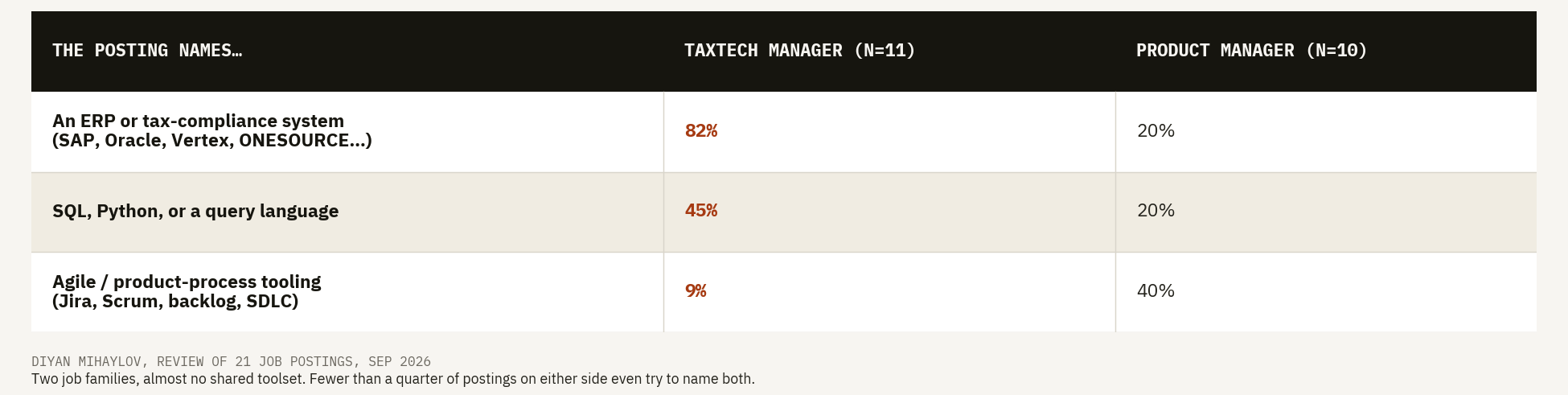
You can see the same split in what each posting actually names. 82% of TaxTech Manager postings name an ERP or a tax-compliance system on day one. 20% of Product Manager postings do. Flip it round: 40% of Product Manager postings name Agile or product-process tooling. 9% of TaxTech Manager postings do. These aren’t two flavors of the same job. They’re two different hiring managers, writing to two different worlds, who happen to share the word “tax” in the title.
Criteria 4: how’s AI shaping the two roles
This never came up with Paul, but I think it matters because the two roles use AI differently. So, it also shows a subtle difference between them.
For the product manager, AI collapsed the distance between the idea and the finished product.
I used to write a spec and wait. Now I can build a rough version of an integration or a customer experience flow, watch it fail, and understand why before anyone commits to building a fully fledged version of it. Most PMs have already stopped writing documents and started writing prototypes that are wrong in interesting ways. So, a Tax PM can use AI to build entire flows.
For the tax technology role, AI added a job nobody trained for.
That person now has to evaluate probabilistic systems, which is a completely different skill from evaluating deterministic ones. A tax professional can tell you whether an answer is right. Very few can tell you whether an answer is right 91% of the time in a way that fails safely (i.e. an answer based on evals or a fully fledged harness). So, TaxTech Managers use AI for a lot less currently.
Whether the two roles are diverging or converging at this point is hard to say. But they are definitely not using AI to do the same thing.
So which one do you need?
To answer this question, let’s compare the two roles holistically.
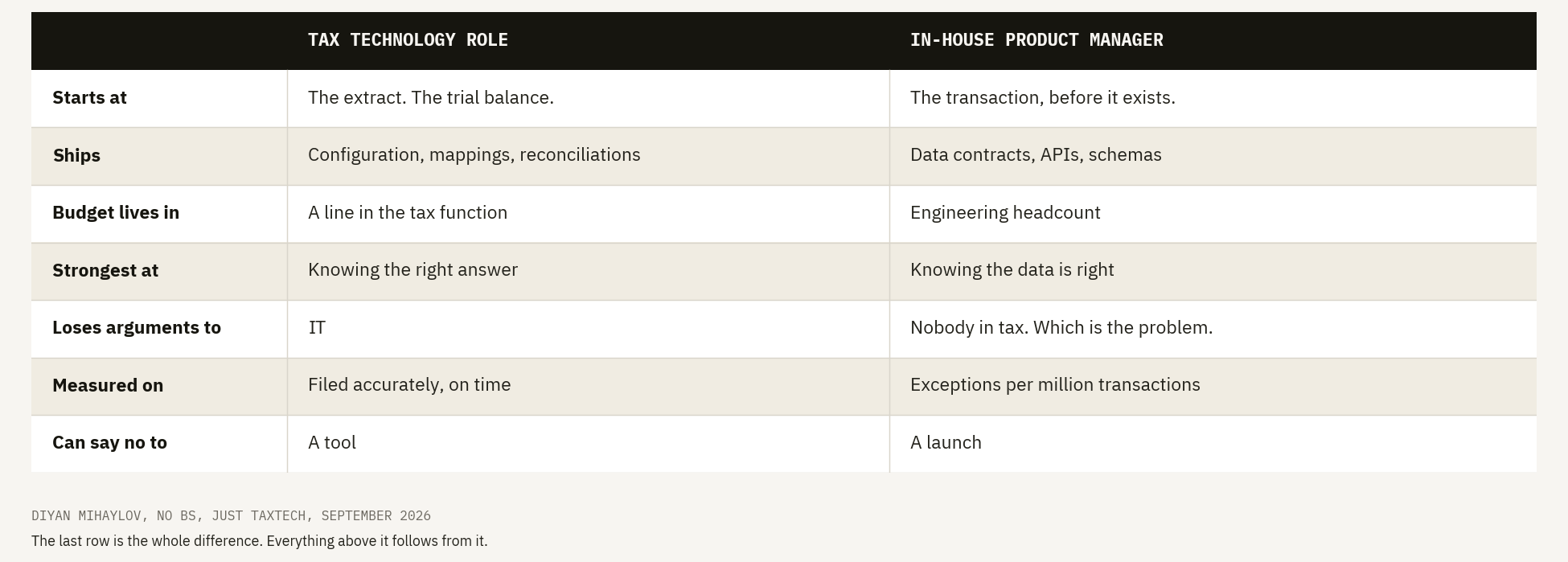
Based on the above, here’s how to tell which seat you’re short of.
1️⃣ Missing the tax technology seat? Filings are late or wrong, and nobody can say why. Reconciliations live in a spreadsheet one person can open. Somebody bought a tool eighteen months ago that still isn’t configured, and everyone has quietly stopped mentioning it.
2️⃣ Missing the product seat? Tax finds out at launch. Nobody owns the schema. Master data holds three versions of the same entity, and each system picked a different one. Worst case, your tax requirements are not even mentioned or integrated into your checkout flow.
One thing to do this week: read five job postings for the seat you’re missing. Main goal: to see what the market thinks that job actually requires. Faster diagnostic than any internal audit you’ll get approved. If a launch next quarter created a tax fact your systems can’t represent, who has the standing to delay it?
Before you go, here’s also the short teaser for my discussion with Paul:
You can also check the full publication that ran on the Nexus last week.



